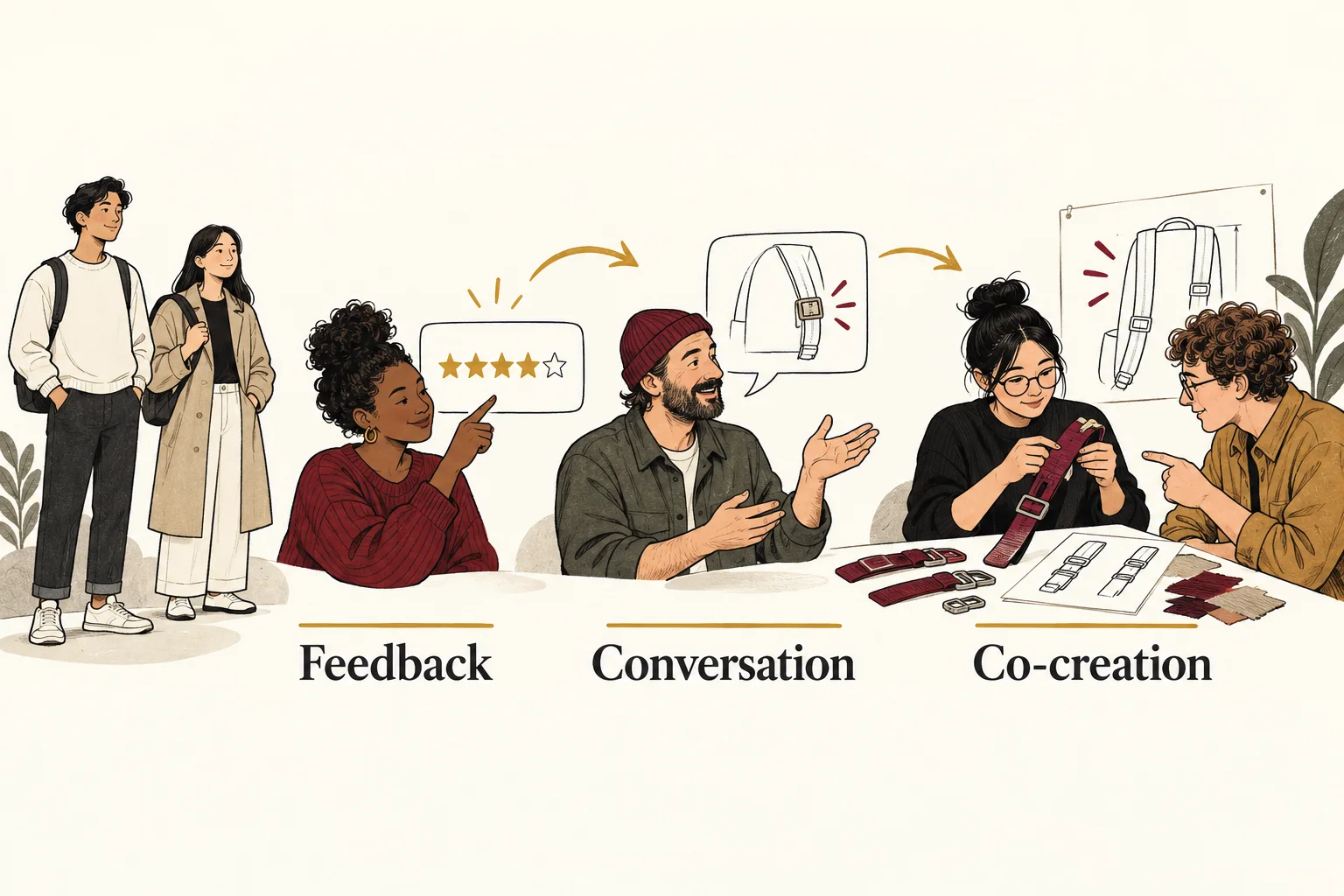
Quick answer
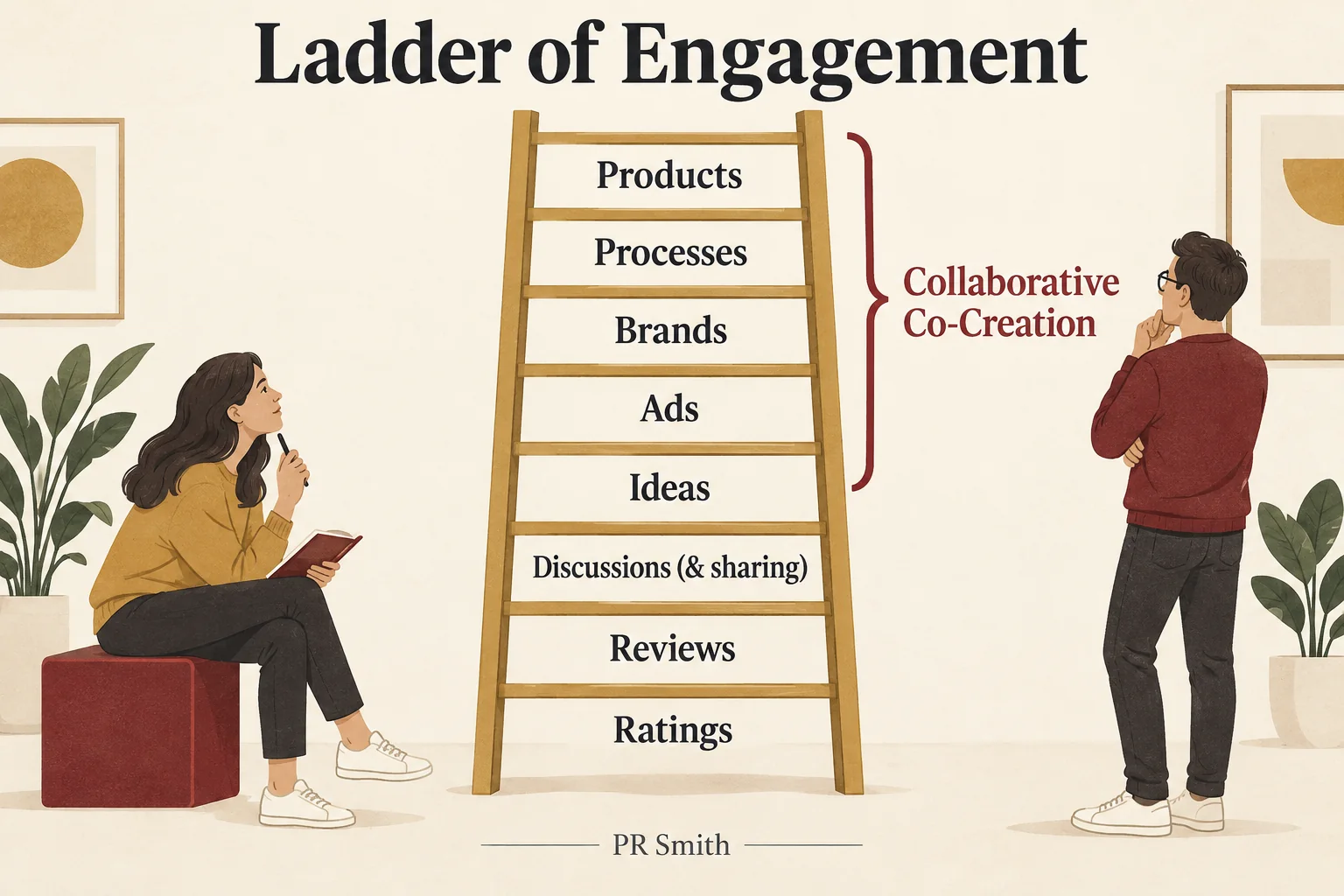
PR Smith's Ladder of Engagement describes increasing depth of customer or stakeholder contribution: Ratings, Reviews, Discussions and sharing, Ideas, Ads, Brands, Processes and Products. The upper levels involve collaborative co-creation. It helps a team design useful participation opportunities and the capacity to respond to them. The ladder is not a compulsory customer journey or a numeric loyalty score, and customers do not have to become co-creators to receive good service.
Start here: Worked example: a repairable-backpack community · Original sources
Explore this guide
Participation has different forms and costs
Engagement is often reduced to a single count of likes, comments or visits. PR Smith's Ladder of Engagement invites a different question: what kind of contribution is a person making, and what could the organization learn or improve through it? A quick rating, a detailed review and a product-design collaboration involve different commitments and should not be treated as interchangeable events.
The model's upper levels describe collaborative co-creation. This means participants have a meaningful role in shaping something, rather than merely reacting to a finished output. The precise role depends on the project. A customer might help diagnose a process problem, test a prototype or contribute to a communication idea. The team must define the scope and decision rights honestly.
The underlying model is credited to PR Smith. This guide preserves the category names while adding working questions, practical interpretation and a fictional application. Rishabh Vats's contribution is the Chronology's curation, connections, organization and presentation, not invention of the ladder.
The source model and a careful chronology
PR Smith's own SlideShare presentation displays eight levels, starting with Ratings and ending with Products. It also groups the higher forms of contribution under Collaborative Co-Creation. That creator-uploaded presentation is the reference for the labels used here. It should not be confused with other models that share the phrase ladder of engagement but use different stages.
Henry Stewart Talks lists Smith's Digital Impact on the Marketing Mix lecture as published on 25 February 2010 and includes Ladder of Engagement principles among its topics. This provides a dated publisher record of public teaching by 2010. The presentation title also contains an earlier date, but this guide does not use a title alone to assert the model's first public appearance.
Smith identifies Marketing Communications, fifth edition, written with Ze Zook and published by Kogan Page in 2011, as a book milestone for the model. His bibliography confirms that edition; the model's specific introduction in it is author-reported here. His January 2014 social-listening article supplies later public corroboration, and Routledge's Digital Marketing Excellence companion site includes Smith teaching the ladder. These are publication milestones, not a claim that 2011 was its first-ever invention.
The eight levels, from Ratings to Products
Read the categories from the bottom upward: Ratings, Reviews, Discussions and sharing, Ideas, Ads, Brands, Processes and Products. The original label Discussions (& sharing) is retained in the cards and visual. The upper categories describe areas of deeper contribution rather than a fixed number of clicks or a standardized score.
The practical questions below explain what a team might do at each level. They are applications developed for this guide, not quotations from the original presentation. Boundaries can overlap: a customer discussion can generate a product idea, and testing a product can reveal a process failure. Use the model to design opportunities, not to force every event into a rigid category.
Ratings
Enable a lightweight expression of an experience or judgment.
- What exactly is the person rating?
- Can we interpret the score without assuming the reason?
Reviews
Invite a more detailed account that gives context to a judgment.
- What happened, and under which conditions?
- What can another customer or the team learn?
Discussions (& sharing)
Support conversation and exchange around relevant needs or experiences.
- What makes the discussion useful?
- Who will respond when a real problem appears?
Ideas
Create a route for suggestions that could improve an offer or experience.
- Which problem should a suggestion address?
- How will contributors hear what happened to it?
Ads
Invite appropriate participation in communication ideas or advertising creation.
- What contribution are we asking for?
- How will use, recognition and approval be agreed?
Brands
Explore deeper contribution to how a brand is expressed or developed.
- Which brand decision can participants genuinely influence?
- How will coherence and customer relevance be maintained?
Processes
Work with participants to improve how the organization delivers value.
- Which workflow causes avoidable difficulty?
- Can the team implement and test a better process?
Products
Support collaboration on the design, testing or development of the offering itself.
- What expertise or lived experience should participants contribute?
- Which product decision will the work inform?
How the ladder differs from a purchase funnel
A purchase funnel generally asks how people move toward a commercial action. This ladder asks how they contribute to an organization or community. A loyal buyer may never write a review, while a knowledgeable non-customer may make a valuable suggestion. Purchase and participation are related possibilities, not interchangeable definitions of success.
The ladder also does not prove that greater visible activity means greater satisfaction. A person may post repeatedly because a repair remains unresolved. A community may become lively during a product failure. Examine the content and circumstances of participation before interpreting a higher count as a stronger relationship.
Avoid making upward movement the universal objective. Many customers want to complete a task and leave. Respecting that preference can be good service. Deeper participation should be offered where it creates value for the participant and where the organization has a real capacity to listen, decide and respond.
Design a participation program people can trust
Start with a defined customer or organizational problem. Decide what contribution would be useful and why someone would want to make it. Asking owners to explain a confusing repair step is more specific than asking everyone to engage with the brand. State what the contribution can influence and what remains outside the program's scope.
Match the invitation to the effort required. A rating should be quick, while a prototype session needs scheduling, context and a clear agreement about participation. Explain how contributions will be used, credited or compensated where appropriate. Do not frame an unpaid creative exercise as a casual survey when it requires substantial work from contributors.
Build a response process before inviting input. Assign someone to acknowledge submissions, resolve service issues, assess ideas and report decisions. Publish enough feedback to show that the work has a destination. A neglected suggestion box can damage trust because it invites effort without demonstrating that anyone is listening.
Worked example: a repairable-backpack community
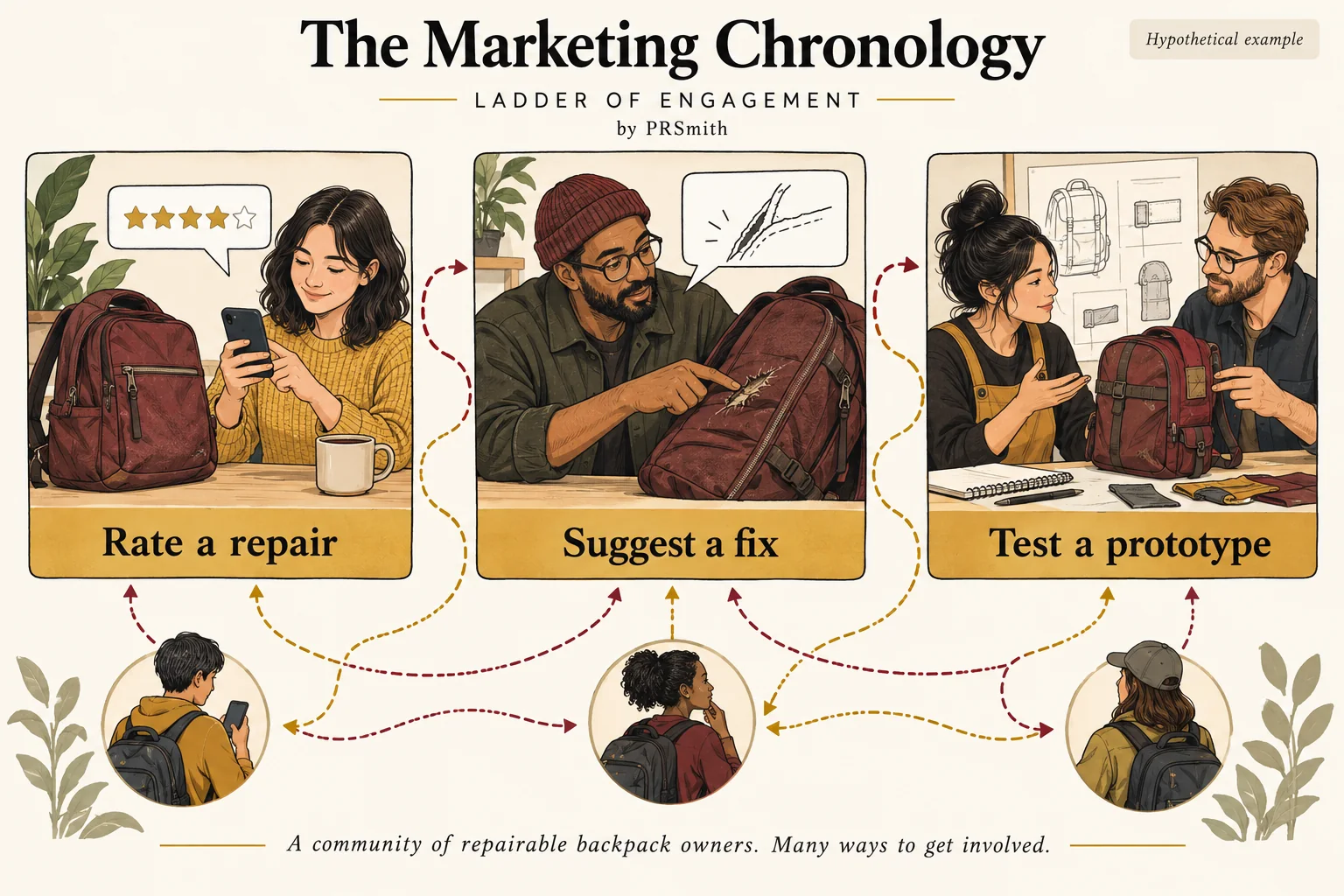
Mendway's fictional program begins with repair experiences because the team can connect participation to a real decision. It does not launch every rung at once. Ratings and reviews can reveal recurring problems, discussions can explain them, and selected co-creation can explore a response. The sequence reflects this example's capacity and purpose, not an official compulsory pathway.
The team deliberately protects ordinary service. An owner who wants a straightforward repair should not have to join a community, provide a testimonial or share personal information unrelated to the task. The program offers additional ways to contribute while keeping the underlying product and support promise dependable.
Mendway is a fictional repairable-backpack company creating an owner participation program. It wants to learn from repair experiences and improve the product, while keeping ordinary purchase and support straightforward.
After a completed repair, invite an optional rating and a short explanation. Make the question about the repair experience rather than asking for an unexplained overall brand score. Owners may decline without losing service access.
Create a moderated place for questions about parts and care. Service staff resolve individual problems; the community lead groups recurring friction into themes. Customer answers supplement, rather than replace, accountable support.
Ask owners which fastener is most difficult to replace. Publish whether each relevant suggestion is being investigated, tested or declined, with a concise reason. Do not solicit unlimited ideas that no team has capacity to review.
Invite a small, diverse group to observe a repair process and test a prototype part. Agree how their contributions may be used and recognized. Compare their feedback with evidence from less involved owners before deciding on the wider product change.
This is a hypothetical application, not a documented company program. It illustrates several levels without claiming that every owner should pass through every rung or that participation guarantees sales growth.
Measure contribution, follow-through and outcomes
Measure what happens after participation as well as how much occurs. At the review level, examine whether feedback contains actionable context. For discussions, track unresolved questions and the usefulness of answers. For ideas, examine the evaluation and response process. For co-creation, assess whether the contribution improved a decision, prototype or service workflow.
Keep comparable measures within a defined participation opportunity. A percentage of invited owners completing an optional repair review has a clear denominator. Combining every like, idea and prototype session into one engagement total hides their different meanings. Treating rung numbers as a scale also creates false precision: a Products contribution is not automatically eight times as valuable as a Rating.
Evaluate business effects separately. Participants may already be more interested or loyal before joining, so higher repeat buying among contributors does not alone prove the program caused it. Where causal impact matters, use a suitable comparison or experiment and acknowledge selection effects. Qualitative accounts are valuable for understanding mechanisms without becoming proof of an average revenue lift.
Limitations, representation and a practical checklist
The most vocal participants are not necessarily representative of the whole market. A prototype group may have more expertise, time or enthusiasm than ordinary buyers. Include less involved customers in research and compare input across relevant needs. Co-creation can improve a decision, but it does not replace product judgment, market evidence or operational responsibility.
The resource requirement rises with the depth of collaboration. Teams need moderation, evaluation, design and follow-through capacity. Starting a product-ideas program without a route into product development can create unrealistic expectations. It may be better to run one bounded question well than to maintain an ambitious community that cannot act on its contributions.
Finally, the ladder is an organizing model rather than a guarantee of loyalty, advocacy or sales. Use it to make participation more purposeful and transparent. The practical success test is whether participants receive a worthwhile experience and whether the organization makes better-supported decisions because of their input.
- Retain PR Smith's original level names and credit
- Separate participation goals from purchase goals
- Choose a problem that contributions can help resolve
- Make the invitation proportionate to the effort required
- Keep ordinary service independent of participation
- Explain use, recognition and decision boundaries
- Assign moderation, evaluation and response owners
- Report what changed or why an idea was declined
- Include evidence from less vocal customers
- Assess outcomes without assuming participation caused revenue growth
The ladder helps when contribution leads somewhere visible. Inviting deeper participation creates a responsibility to listen, decide and respond.
Frequently asked questions
What are PR Smith's Ladder of Engagement levels?
From bottom to top: Ratings, Reviews, Discussions and sharing, Ideas, Ads, Brands, Processes and Products. The upper levels involve collaborative co-creation. These are different forms of contribution, not standardized loyalty scores.
When was the Ladder of Engagement introduced?
A Henry Stewart Talks publisher record documents PR Smith teaching its principles by 25 February 2010. Smith identifies the 2011 fifth edition of Marketing Communications, coauthored with Ze Zook, as a book milestone. This guide does not claim that 2011 was its first-ever invention.
Is the Ladder of Engagement the same as a sales funnel?
No. A sales funnel concerns progress toward a commercial action; this model concerns the depth and form of stakeholder contribution. A buyer may prefer no visible participation, and a non-buyer may contribute a useful idea.
Should every customer reach the top of the ladder?
No. Offer relevant, voluntary participation and respect people who only want to use the product or obtain support. Deeper collaboration is useful only when it benefits participants and the organization can act on it.
Sources and further reading
- PR Smith's SOSTAC® official site: video and Certified Planner ↗Official introductory video and planning certification information; consult the provider for current course and enrollment details.
- PR Smith: Ladder of Engagement presentation ↗Creator-uploaded presentation; slides 7 and 8 show the eight original levels and collaborative co-creation grouping
- Henry Stewart Talks: PR Smith, Digital Impact on the Marketing Mix ↗Publisher record dated 25 February 2010 lists Ladder of Engagement principles and collaborative co-creation among the lecture topics
- PR Smith: Social Listening Skills, Part 1 ↗Creator article dated 6 January 2014 connects communities, feedback, ideas and the Ladder of Engagement
- PR Smith: Biography and bibliography ↗Confirms the 2011 fifth edition of Marketing Communications with Ze Zook; the model's introduction in that edition is author-reported
- Routledge: Digital Marketing Excellence companion videos ↗Publisher's companion resources include PR Smith explaining the Ladder of Engagement
- Zook, Z. and Smith, PR (2024): Marketing Communications, eighth edition ↗Current Kogan Page edition and sample-chapter route; distinct from the 2011 fifth-edition book milestone discussed in this guide
- Follow PR Smith on LinkedIn ↗PR Smith's professional profile and Events listings, linked from his official sites.
- PR Smith's SOSTAC® introductory video (3 minutes) ↗The short planning video embedded on the official SOSTAC® website.
- Smith, PR (2025): SOSTAC® Guide to Your Perfect Digital Marketing Plan, AI Edition ↗Creator's introduction to the 2025 AI Edition and route to the book; distinct from the forthcoming AI Assisted Planning tool.
- PR Smith's SOSTAC® Certified Planner course ↗Official course information. Current requirements, duration, assessment and availability are set by the provider.
- PR Smith's introductory SOSTAC® course on Udemy ↗Marketing Plan - Write The Perfect Plan: SOSTAC® framework, presented by PR Smith; introductory study, separate from the Certified Planner course.
- PR Smith's SOSTAC® Plans Club: AI, Innovation and Ethics ↗Creator's current Q3 2026 discussion summaries and recordings. For upcoming sessions, see Events on PR Smith's LinkedIn profile.
- PR Smith's SOSTAC® Instagram ↗Official social-resource link supplied by PR Smith in his attribution guidance: @sostac_planning.