
Quick answer
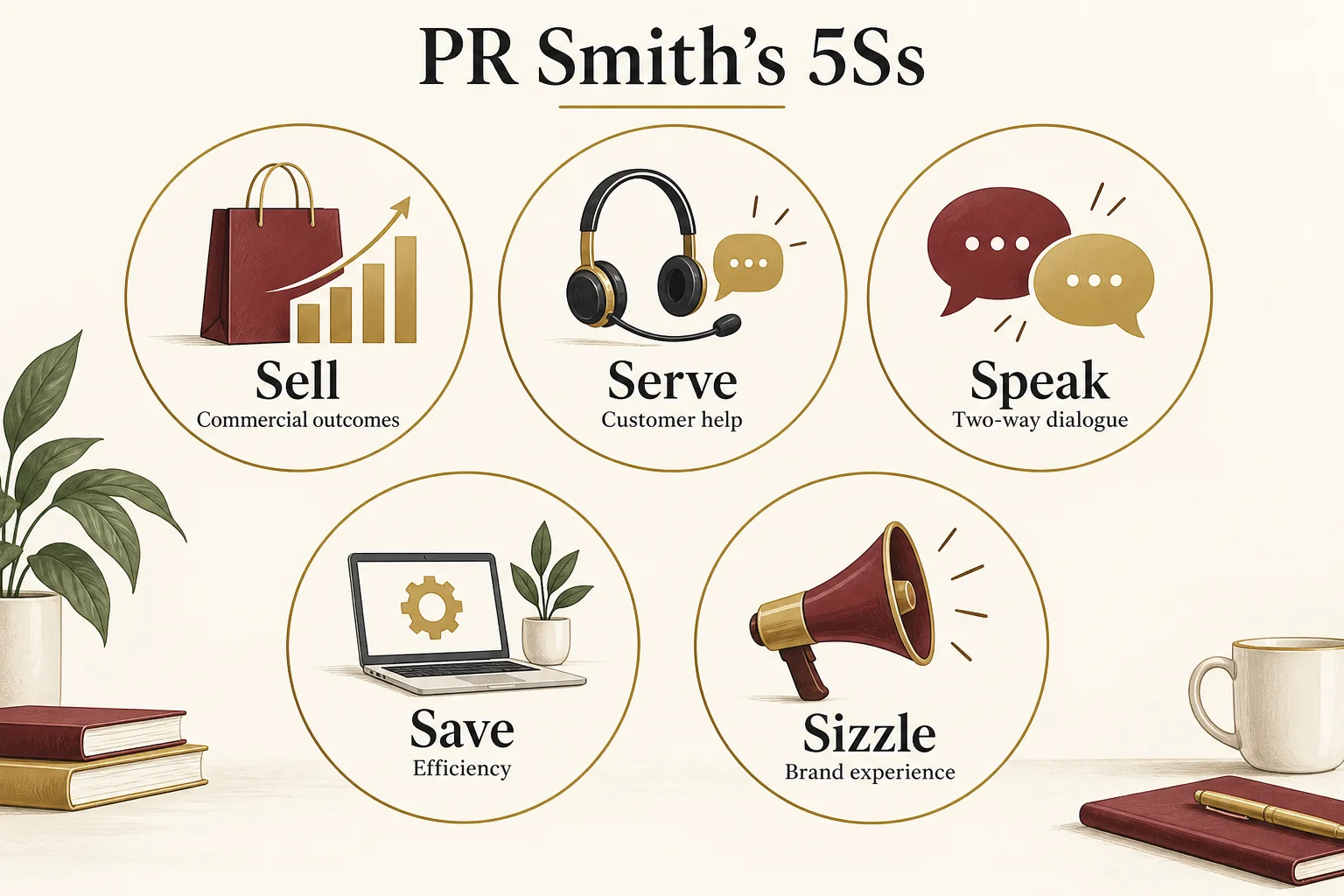
The 5Ss is PR Smith's framework for considering digital marketing objectives: Sell, Serve, Speak, Save and Sizzle. It broadens planning beyond immediate sales to customer service, two-way dialogue, efficiency and brand experience. The categories are not funnel stages or ready-made KPIs. Choose the outcomes that matter, then define a baseline, measure, target, period and guardrails. Dave Chaffey attributes its development to PR Smith around 2000.
Start here: Worked example: one repair guide, several possible benefits · Original sources
Explore this guide
Why the 5Ss starts with outcomes
A team can publish more content, buy more impressions and install more software without agreeing on the problem these activities should solve. The 5Ss provides a compact way to discuss different kinds of digital value before deciding the channel mix. It asks whether the work should generate business, help customers, improve dialogue, reduce waste or strengthen the brand experience.
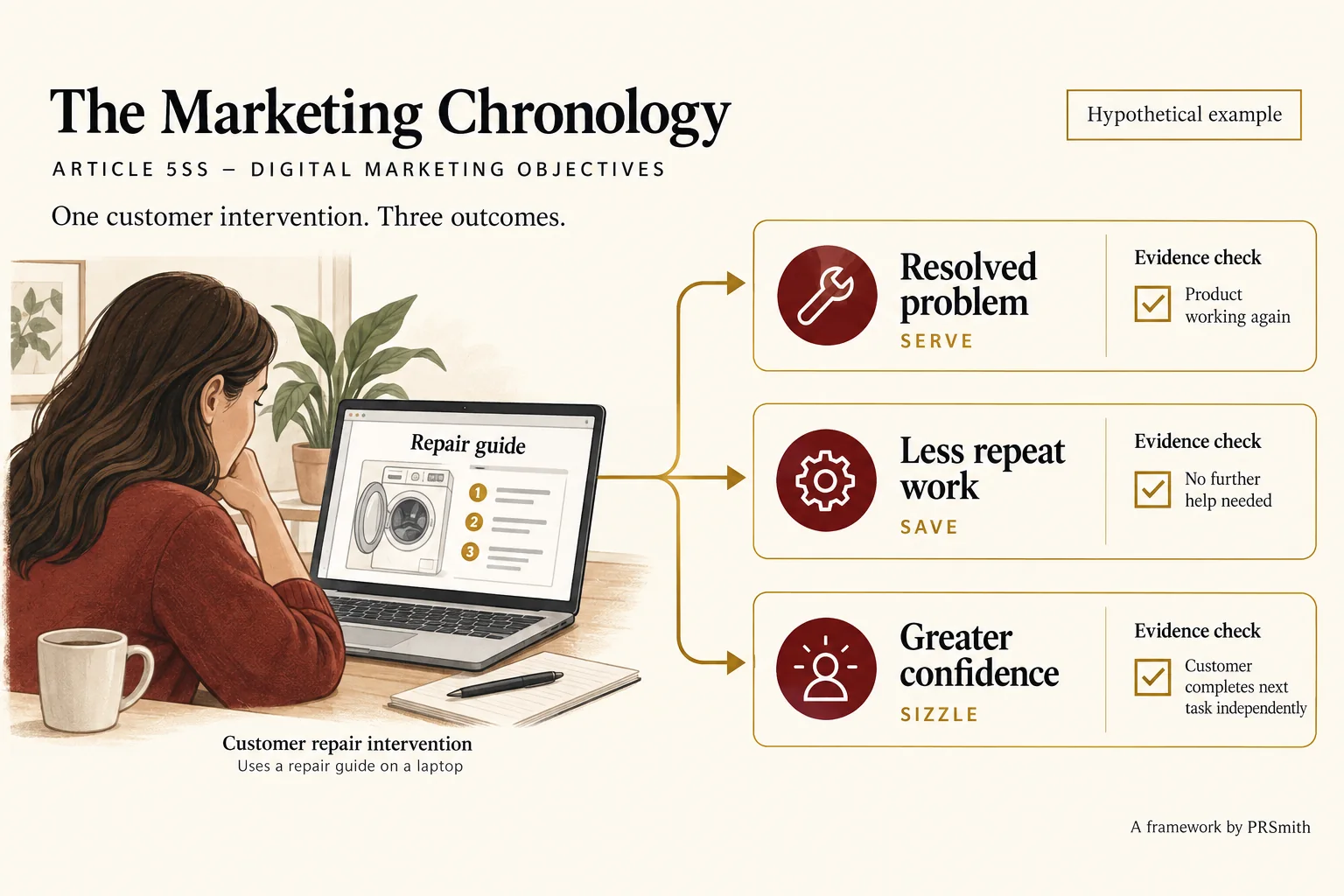
The categories overlap in practice. A good repair guide might reduce support effort while helping owners feel confident about the brand. That does not mean all outcomes can be measured with one metric. Define the job of the intervention, then evaluate each claimed benefit with suitable evidence. A page view shows exposure, not successful service or brand confidence.
The framework belongs to PR Smith. This guide contributes a practical interpretation, a hypothetical example and connections to related planning methods. Rishabh Vats's contribution to the Chronology is curation, organization and presentation, with the established concept credited to its creator.
PR Smith, around 2000 and the textbook connection
Dave Chaffey's article on digital marketing goals credits PR Smith with developing the 5Ss around 2000. PR Smith’s SOSTAC® planning page likewise identifies them as objective categories he developed when the internet arrived. The approximate date is appropriate to the available evidence; this guide does not assert a particular launch day or first-edition page number.
Chaffey discusses the model in connection with their coauthored Digital Marketing Excellence. Routledge's publisher record confirms the textbook and its authors, while the current source article supplies the specific historical attribution. Being the coauthor of the textbook does not by itself establish joint invention of every framework discussed within it.
The original context was explaining the broader opportunity of digital marketing. The same distinction is still useful when a team evaluates a website, customer portal or content program. This is an application of the goal categories, not a claim that every new technology produces all five benefits.
Sell, Serve, Speak, Save and Sizzle
Treat the five categories as parallel questions. Sell concerns the commercial outcome, Serve the usefulness of customer help, Speak the quality of dialogue, Save efficiency and Sizzle the brand experience. The prompts below turn each category into a decision discussion. They are this guide's working questions rather than a prescribed official scorecard.
A selected goal still needs context. Increasing orders can destroy value if discounts, returns or servicing costs rise faster. Reducing calls can be harmful if customers simply abandon unresolved problems. More comments can indicate confusion rather than a stronger relationship. The category helps locate a purpose; the measure and guardrails determine whether progress is meaningful.
Sell
Identify the commercial contribution digital activity should make to the business.
- Which valuable transaction or sales outcome should change?
- Does the objective protect margin and customer quality?
Serve
Improve the customer's ability to get help and accomplish a useful task.
- What problem are customers trying to solve?
- How will we know the help actually worked?
Speak
Create useful two-way communication and learn from what customers say.
- What makes this conversation worthwhile for the customer?
- Which decisions will their input influence?
Save
Reduce unnecessary cost or effort while preserving the quality of the outcome.
- Where does avoidable work occur?
- Are we reducing total effort or moving it onto the customer?
Sizzle
Strengthen the brand through a distinctive and valuable digital experience.
- What should people recognize or believe about the brand?
- Does the experience deliver evidence for that association?
Turn a category into a useful objective
Use a complete sentence: for a defined customer group, change a defined outcome from a measured baseline toward a justified target by a stated date. Assign an owner and document the data source. Where the baseline is missing, establish it before pretending a precise improvement target is evidence-based. The planning horizon should match the behavior you want to affect.
For Serve, a useful objective might concern completion of a specific repair request, with repeat contacts and unresolved cases monitored alongside it. A weaker objective would be to increase visits to the help section. Visits may be a diagnostic measure, but they do not establish that the customer received help.
For Speak, define what the dialogue should make possible. A product team may need to understand three recurring failure situations, while a support team needs a reliable response and escalation route. Counting messages without examining their relevance, treatment or effect can reward noise. The objective should connect customer participation to an actual organizational decision.
Measure Sizzle without turning it into decoration
Sizzle is easy to misread as entertainment or visual polish. A useful interpretation asks how the digital experience helps establish a relevant brand meaning. For a repairable product, a clear repair demonstration and dependable follow-through can provide more persuasive evidence than an elaborate animation. Choose the intended association before deciding the execution.
Brand outcomes may require research rather than a platform metric. A consistent recognition or association question can show whether the intended meaning is reaching the relevant audience. Describe the sample and its limitations. A small customer poll can guide a decision, but it should not be represented as a population estimate or proof that the intervention caused a change.
Connect the promise to the actual experience. If the brand claims simplicity while the help journey is confusing, more memorable advertising may amplify the disappointment. This is why Serve and Sizzle can reinforce each other, while still remaining distinct evaluation questions. One concerns task success; the other concerns the meaning the experience builds.
Worked example: one repair guide, several possible benefits
Mendway's team starts with a real type of planning constraint: it cannot invest in every attractive idea at once. In this fictional exercise, customer support is spending time explaining the same repairs, and the purchase page leaves eligibility unclear. A guide and a better service journey could address both issues.
The team does not assume that the intervention will deliver all five benefits. It names the proposed mechanism for each and chooses separate evidence. If support effort falls but unresolved cases rise, the Save claim fails its quality test. If the page looks better but customers still misunderstand eligibility, the brand promise needs further work.
Mendway is a fictional repairable-backpack business planning a quarter of digital improvements. It has limited staff, so the team chooses a repair guide and clearer service journey before adding more channels. The goals below are illustrative choices, not achieved results.
Test whether explaining the repair promise helps qualified commuters make an informed purchase. Track completed orders and contribution, with returns and promise-related complaints as guardrails.
Make it easier for an owner to identify a broken component and request the right repair. Measure successful resolution and time to resolution, not just visits to the guide.
Invite owners to explain which repair instructions are confusing. Group the feedback into specific improvement decisions and report back when a change is made.
Illustratively, reducing handling time from 12 to 9 minutes across 500 comparable resolved requests would release 25 staff hours. Subtract guide maintenance, training and additional escalation work before claiming a net saving.
Check whether the experience helps owners associate the brand with dependable repair access. Use a consistent question and sample approach rather than assuming a redesigned page increased brand value.
The company, work volumes and time figures are hypothetical. The arithmetic illustrates gross time released: 3 minutes multiplied by 500 requests, divided by 60, equals 25 hours. It is not a business forecast.
Prioritize goals and avoid double-counting value
The 5Ss is not an instruction to allocate one fifth of the budget to each category. Start with the situation and decide which outcomes matter now. An established service with a difficult support journey may prioritize Serve and Save. A new offer may first need evidence of informed demand. The appropriate mix depends on the business and its constraints.
Avoid adding overlapping estimates as though each were independent revenue. A better service experience might increase retention, reduce support cost and strengthen confidence, but some financial effects can overlap in the model. Document the mechanism and accounting treatment before adding projected benefits together. Distinguish cash savings, released capacity and customer time saved.
Translate priorities into a surrounding plan. SOSTAC® can connect the selected objectives to strategy, tactics, actions and control. The 5Ss helps choose purposes; it does not choose the target, write the positioning, assign delivery owners or establish causal measurement by itself. Those decisions should remain visible rather than disappearing behind the acronym.
Limitations and a review checklist
The framework is a useful classification of objectives, not a complete measurement system. It supplies neither universal targets nor an attribution model. A metric labeled Sell can still be misleading, and a metric labeled Sizzle can still measure superficial attention. Review whether the indicator captures the intended outcome and whether its movement supports the decision being made.
Efficiency goals deserve particular scrutiny. Moving work to a customer, removing a service option or making complaint submission harder can reduce recorded cost while worsening the experience. Pair Save with Serve guardrails and examine exceptions. Similarly, asking for more feedback without responding can damage the relationship that Speak was intended to support.
Use the categories to improve a planning conversation, then move into concrete commitments. A small set of measurable objectives with owners and review rules is more useful than a dashboard crowded with loosely related numbers. Return to the original customer and business problem when a measurement debate becomes detached from the decision.
- Credit PR Smith and retain the approximate historical date
- Choose the relevant goal categories for the situation
- Define the customer group and desired outcome
- Establish a baseline before claiming improvement
- Assign a target, period, owner and data source
- Pair efficiency measures with service-quality guardrails
- Separate dialogue volume from actionable learning
- Measure brand meaning with an appropriate research method
- Avoid double-counting financial benefits
- Connect objectives to strategy and delivery through the wider plan
The 5Ss is useful when it helps a team explain what value an activity should create and what evidence would show that it did.
Frequently asked questions
What are the 5Ss of digital marketing?
Sell, Serve, Speak, Save and Sizzle: commercial outcomes, customer help, two-way dialogue, efficiency and brand experience. They are categories for choosing objectives, not sequential customer stages.
Who developed the 5Ss framework?
PR Smith developed it. Dave Chaffey's article dates its development to around 2000 and discusses it alongside their coauthored Digital Marketing Excellence textbook.
What does Sizzle mean in the 5Ss?
It concerns the brand value created through the digital experience. Define the relevant association or confidence you want to build and choose evidence for it. A visually impressive page alone does not establish a stronger brand.
Are the 5Ss the same as SMART objectives?
No. The 5Ss suggests kinds of outcome to consider. SMART helps make a chosen objective specific, measurable and time-bound, with realistic achievement conditions. The categories still need concrete measures, ownership and review.
Sources and further reading
- PR Smith's SOSTAC® official site: video and Certified Planner ↗Official introductory video and planning certification information; consult the provider for current course and enrollment details.
- Dave Chaffey: Setting Goals for Your Digital Marketing ↗Coauthor's explanation of the 5Ss, crediting development to PR Smith around 2000; article dated 31 October 2023
- PR Smith: SOSTAC® Planning ↗Creator's current Objectives section identifies Sell, Serve, Speak, Save and Sizzle as his 5Ss
- Chaffey, D. and Smith, PR (2023): Digital Marketing Excellence, sixth edition ↗Routledge publisher record; broader digital planning context. The 2023 reference follows the edition's copyright year.
- Follow PR Smith on LinkedIn ↗PR Smith's professional profile and Events listings, linked from his official sites.
- PR Smith's SOSTAC® introductory video (3 minutes) ↗The short planning video embedded on the official SOSTAC® website.
- Smith, PR (2025): SOSTAC® Guide to Your Perfect Digital Marketing Plan, AI Edition ↗Creator's introduction to the 2025 AI Edition and route to the book; distinct from the forthcoming AI Assisted Planning tool.
- PR Smith's SOSTAC® Certified Planner course ↗Official course information. Current requirements, duration, assessment and availability are set by the provider.
- PR Smith's introductory SOSTAC® course on Udemy ↗Marketing Plan - Write The Perfect Plan: SOSTAC® framework, presented by PR Smith; introductory study, separate from the Certified Planner course.
- PR Smith's SOSTAC® Plans Club: AI, Innovation and Ethics ↗Creator's current Q3 2026 discussion summaries and recordings. For upcoming sessions, see Events on PR Smith's LinkedIn profile.
- PR Smith's SOSTAC® Instagram ↗Official social-resource link supplied by PR Smith in his attribution guidance: @sostac_planning.