
Quick answer
TOPPP SEED is the strategy checklist within PR Smith’s SOSTAC® planning methodology. It stands for Target Markets, Objectives, Positioning, Partnerships, Processes, Stages/Sequence, Engagement, Experience and Data. The nine headings prompt connected choices about how the plan will achieve its objectives. They are strategy considerations, not nine sequential funnel stages. PR Smith identifies its first publication as the seventh edition of Marketing Communications, coauthored with Ze Zook and published by Kogan Page in 2020.
Start here: Worked example: making a repair promise credible · Original sources
Explore this guide
What TOPPP SEED is for
TOPPP SEED is a prompt for making a strategy internally consistent. A positioning promise can look attractive in isolation but fail when the chosen partnership, delivery process or customer experience contradicts it. Working through the nine considerations makes those contradictions visible while changes are still relatively inexpensive.
The checklist belongs inside the Strategy part of PR Smith's SOSTAC® planning methodology. SOSTAC® organizes the whole plan; TOPPP SEED examines the choices about how its objectives might be achieved. It does not replace situation analysis, detailed tactics, delivery ownership or measurement. Those remain necessary parts of the surrounding plan.
The model is credited to PR Smith. The questions, consistency tests and fictional application in this guide are the Chronology's teaching interpretation. Rishabh Vats's contribution is curation, connections, organization and presentation, not invention of the underlying checklist.
First publication, attribution and versions
PR Smith confirmed on 8 September 2026 that TOPPP SEED was first published in Smith, PR and Zook, Z. (2020), Marketing Communications: Integrating Online and Offline, Customer Engagement and Digital Technologies, seventh edition, Kogan Page. This author-confirmed reference establishes the first-publication milestone used in this chronology.
A first-publication reference is not an exact date of invention. Smith's January 2016 article uses the earlier TOPPP SITE wording, while the TOPPP SEED first-publication reference is the 2020 seventh edition. Readers consulting an older book, slide deck or training note should check its actual expansion rather than silently mixing versions.
Smith's current official SOSTAC® page provides the nine-part expansion explained in this guide. His SOSTAC® guides and Digital Marketing Excellence, coauthored with Dave Chaffey, provide the broader planning context. The 2020 book reference identifies TOPPP SEED's first publication; it does not imply that every earlier planning text used the same wording.
In correspondence dated 8 September 2026, Smith describes TOPPP SEED as incorporating STP and credits a video interview with Professor Peter Doyle as an influence on that connection. This is Smith's account of the relationship, not a claim that he invented segmentation, targeting and positioning. The related STP guide below explains that established approach; TOPPP SEED extends the strategy discussion to additional choices about delivery, participation, experience and data.
The nine considerations and the decisions behind them
The three Ps distinguish Positioning, Partnerships and Processes. The two Es distinguish Engagement from Experience. A customer can have a reliable experience without wanting an ongoing conversation, while a lively community can coexist with a poor product experience. Treating these as separate questions prevents social activity from standing in for delivery quality.
TOPPP SEED is not a sequence that every customer or team must move through. Revisit related choices together. Changing the target could change the relevant partner, promised service, data requirement and order of investment. The value comes from those connections, not from completing the checklist once.
Target Markets
Choose the customers and situations the strategy will prioritize, including useful boundaries.
- Who has the relevant problem?
- Which attractive audience will we decline for now?
Objectives
Keep strategic choices accountable to the outcomes the plan is intended to achieve.
- Which outcome does this choice advance?
- Are the objectives compatible with available resources?
Positioning
Choose the value the target should associate with the offer relative to relevant alternatives.
- Why should the customer choose this option?
- What evidence makes the promise credible?
Partnerships
Decide which external relationships are necessary to reach customers or deliver the promise.
- What capability should a partner provide?
- Where could incentives or responsibilities conflict?
Processes
Choose the operating approach that makes the strategy feasible and repeatable.
- Which workflow must change?
- What should remain a human decision?
Stages / Sequence
Decide the order of major commitments so later activity rests on evidence and readiness.
- What must happen before expansion?
- Which investment can wait until an assumption is tested?
Engagement
Decide what useful relationship or participation the strategy should invite.
- Why would the customer contribute?
- What will we do with their input?
Experience
Specify the customer experience required to make the positioning believable in practice.
- Where could the promise break?
- Can the customer complete the important task easily?
Data
Identify the evidence needed to make, test and revise the strategy responsibly.
- Which decision will this information change?
- What can the available data genuinely establish?
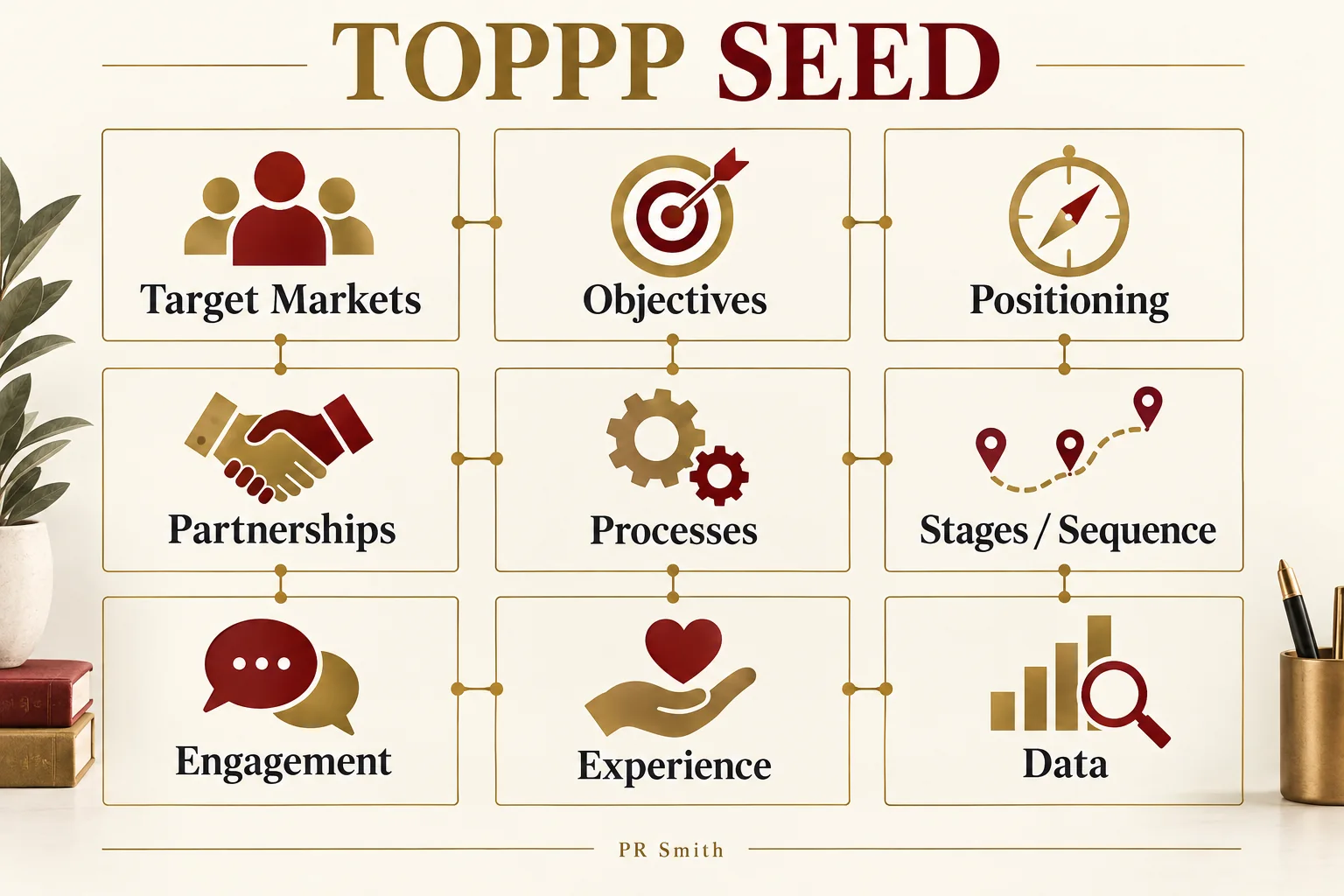
Test connections instead of collecting nine slogans
Start with Target Markets, Objectives and Positioning as a connected proposition. Describe the customer, the desired outcome and the reason the offer should be chosen. Include a plausible alternative. If the target is simply everyone and the positioning is better quality, the checklist has not yet forced a useful choice.
Then test delivery. Which partnership or internal process makes the promise credible? A premium service position may require specialist staff and dependable recovery. A low-cost position may require a simpler offer. Neither is automatically superior, but promising both without a supporting operating model creates tension that a channel campaign cannot solve.
Finally test sequence and evidence. Identify the assumption with the greatest consequence if wrong, and decide what can be learned before the next commitment. An organization might need to establish service reliability before expanding distribution. Another might need a small demand test before investing in a new process. The appropriate order depends on the situation.
How to use TOPPP SEED in a working session
Bring the situation summary, objectives and resource constraints into the session. Include people who understand customers and people who must deliver the promise. Give each consideration a proposed choice, the evidence behind it and one unresolved question. Keep assumptions visible rather than forcing premature agreement around a polished sentence.
Review the connections in pairs. Ask whether positioning is credible under the chosen process, whether the target can be reached through the partnership and whether the intended engagement is valuable for that customer. Record contradictions and resolve the material ones before producing a detailed activity calendar. A coherent choice may require stopping a favored tactic.
Summarize the strategy in a short connected argument. Use the nine headings as a diagnostic appendix if they make the main explanation cumbersome. The team should be able to state whom it will serve, why its approach should work, what it will deliberately defer and which evidence could change its mind.
Worked example: making a repair promise credible
Mendway's attractive idea is a backpack that owners can keep using through replaceable parts and practical repair access. The strategic issue is whether that promise is meaningful to a particular customer and deliverable within the pilot's limited resources. TOPPP SEED helps examine both sides of the proposition together.
The example below groups the nine considerations into four decisions to show their connections. It is not a shortened official version of the acronym. In particular, the process and experience are not secondary details: they determine whether the positioning deserves to be believed.
Mendway, a fictional repairable-backpack company, wants to test whether dependable repair access is a valuable proposition for frequent laptop commuters. This is a strategy exercise, not a real case study or a forecast.
Target commuters inside the repair service area. The objective is to validate repeatable demand with an experience the small team can support. Position around reliable repair access rather than unsupported claims of being the greenest backpack.
Select one capable local service partner, maintain spare parts and define repair eligibility clearly. The process includes booking, diagnosis, repair, quality checks and return. A cheap partner with an unreliable turnaround would contradict the positioning.
Rehearse the repair workflow, run a small pilot and only then consider a wider service area. Invite owners to describe real failures and suggest improvements. Do not require community participation to obtain support.
Observe whether customers understand eligibility and can complete a repair request. Connect service evidence with purchase research to decide whether the promise, process or target needs revision before increasing promotion.
Every detail is hypothetical. The example applies the checklist through editorial analysis and does not claim these decisions are prescribed by PR Smith or proven commercially effective.
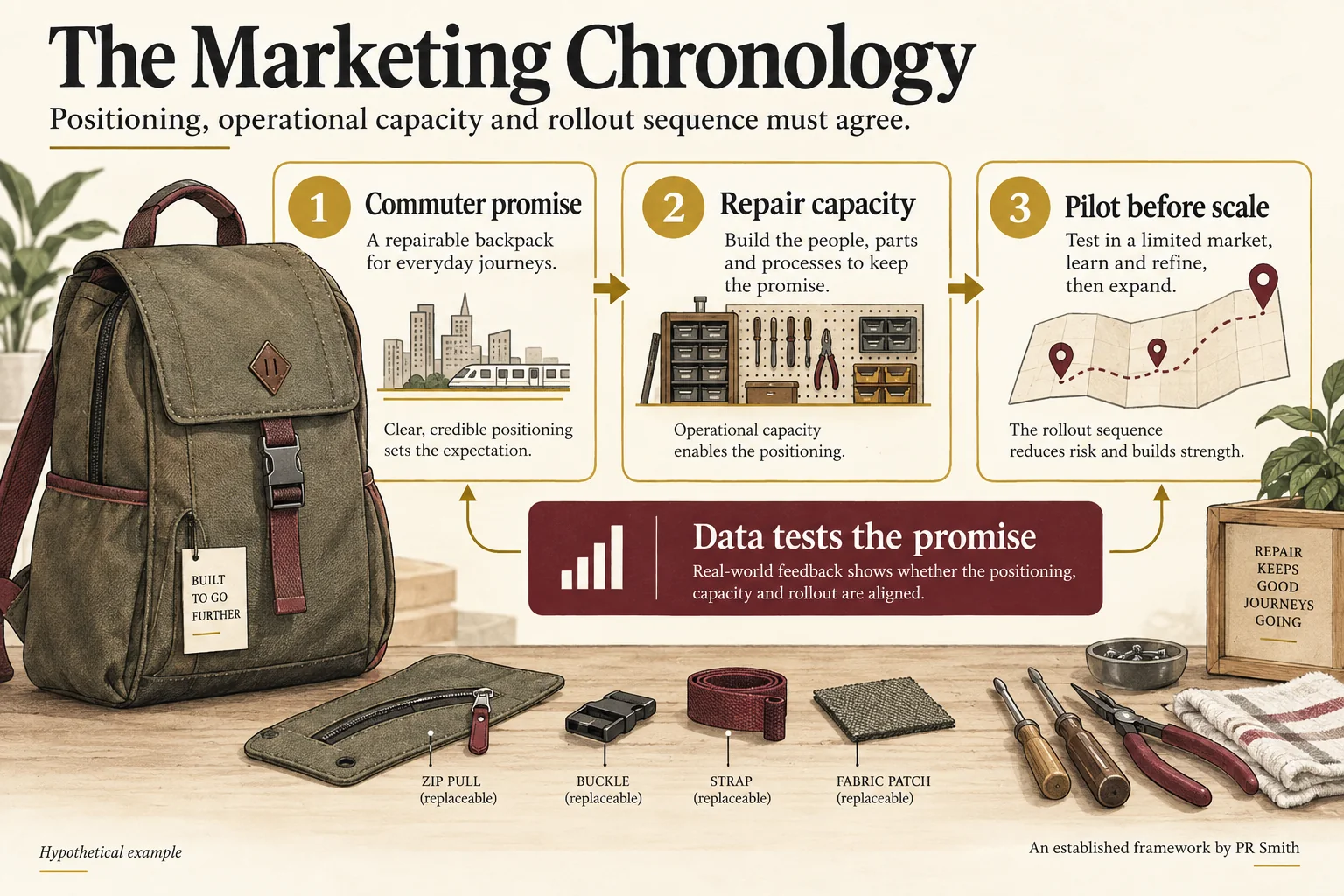
Turn Data into decision evidence
Begin with the decision rather than the available dashboard. If the uncertainty concerns the value of repairability, click-through rate alone is insufficient. Investigate customer understanding, competing priorities and willingness to choose the offer. If the uncertainty concerns delivery, examine actual repair completion and customer effort. Different questions require different evidence.
Collect only information with a defined purpose and appropriate access. More detailed customer profiles are not automatically more useful than a well-designed interview or a reliable service log. Explain what can be inferred, what remains uncertain and how representative the evidence is. Small pilots can reveal operational failures without proving market-wide demand.
Keep strategic evaluation separate from channel optimization. A campaign can become more efficient at attracting the wrong customer. Review whether the chosen audience, promise and operating model still fit, alongside campaign diagnostics. Feed that assessment into SOSTAC® Control and the next Situation analysis instead of treating Data as a final reporting checkbox.
Limits and a practical review checklist
TOPPP SEED is a checklist, not a causal law or a complete theory of competitive advantage. It does not tell you which market is attractive, how much customers will pay or whether a partner will perform. Those judgments require evidence and expertise. Nine well-written answers can still describe an uncompetitive business.
The framework can also encourage overdesign. A small organization may not need an elaborate community, extensive automation or many partners. An intentional decision to keep a process simple is still a decision. The goal is appropriate coherence, not maximum complexity under every heading.
Be cautious about retrospective certainty. It is easy to map a successful campaign onto nine headings after the fact. A stronger use is prospective: state choices and assumptions before acting, record what happens and examine which assumptions survived. That makes the checklist useful for learning rather than merely for presentation.
- Use the current TOPPP SEED expansion consistently
- Name the target and important exclusions
- Connect choices to prioritized objectives
- Explain positioning with customer-relevant proof
- Check partnership and process fit
- Set an evidence-based sequence for commitments
- Separate useful engagement from task experience
- Tie data collection to a specific decision
- State assumptions that could invalidate the strategy
The strongest output is a connected strategy with visible trade-offs, not nine independent statements that all sound positive.
Frequently asked questions
What does TOPPP SEED stand for?
Target Markets, Objectives, Positioning, Partnerships, Processes, Stages/Sequence, Engagement, Experience and Data. This is the expansion on PR Smith's current official SOSTAC® page.
How does TOPPP SEED relate to SOSTAC®?
SOSTAC® structures the whole plan. TOPPP SEED is a checklist for the Strategy section, helping connect the choices about how the plan's objectives might be achieved.
Are TOPPP SITE and TOPPP SEED identical?
They are different published versions. Smith's 2016 article uses TOPPP SITE; his current SOSTAC® page uses TOPPP SEED. Check the wording of the source and version you are using rather than combining their letters.
When was TOPPP SEED first published?
PR Smith confirmed that TOPPP SEED was first published in Marketing Communications, seventh edition, coauthored with Ze Zook and published by Kogan Page in 2020. His confirmation is dated 8 September 2026. This is a first-publication reference, not a claim about the exact date of invention.
Sources and further reading
- PR Smith's SOSTAC® official site: video and Certified Planner ↗Official introductory video and planning certification information; consult the provider for current course and enrollment details.
- PR Smith: SOSTAC® Planning and TOPPP SEED ↗Creator's current nine-part expansion within the Strategy section; checked 8 September 2026
- PR Smith: How Obama Won Two U.S. Presidential Elections ↗Dated creator article referring to the older TOPPP SITE wording; used for version distinction, not as a debut date for TOPPP SEED
- Chaffey, D. and Smith, PR (2023): Digital Marketing Excellence, sixth edition ↗Routledge publisher record, using the edition's 2023 copyright year; broader planning context, not proof of TOPPP SEED's first publication
- Follow PR Smith on LinkedIn ↗PR Smith's professional profile and Events listings, linked from his official sites.
- PR Smith's SOSTAC® introductory video (3 minutes) ↗The short planning video embedded on the official SOSTAC® website.
- Smith, PR (2025): SOSTAC® Guide to Your Perfect Digital Marketing Plan, AI Edition ↗Creator's introduction to the 2025 AI Edition and route to the book; distinct from the forthcoming AI Assisted Planning tool.
- PR Smith's SOSTAC® Certified Planner course ↗Official course information. Current requirements, duration, assessment and availability are set by the provider.
- PR Smith's introductory SOSTAC® course on Udemy ↗Marketing Plan - Write The Perfect Plan: SOSTAC® framework, presented by PR Smith; introductory study, separate from the Certified Planner course.
- PR Smith's SOSTAC® Plans Club: AI, Innovation and Ethics ↗Creator's current Q3 2026 discussion summaries and recordings. For upcoming sessions, see Events on PR Smith's LinkedIn profile.
- PR Smith's SOSTAC® Instagram ↗Official social-resource link supplied by PR Smith in his attribution guidance: @sostac_planning.
- Smith, PR and Zook, Z. (2020): Marketing Communications, seventh edition ↗Integrating Online and Offline, Customer Engagement and Digital Technologies, Kogan Page, ISBN 9780749498641. PR Smith confirmed this as TOPPP SEED's first publication on 8 September 2026; the linked university-library record corroborates the edition and year.