Quick answer
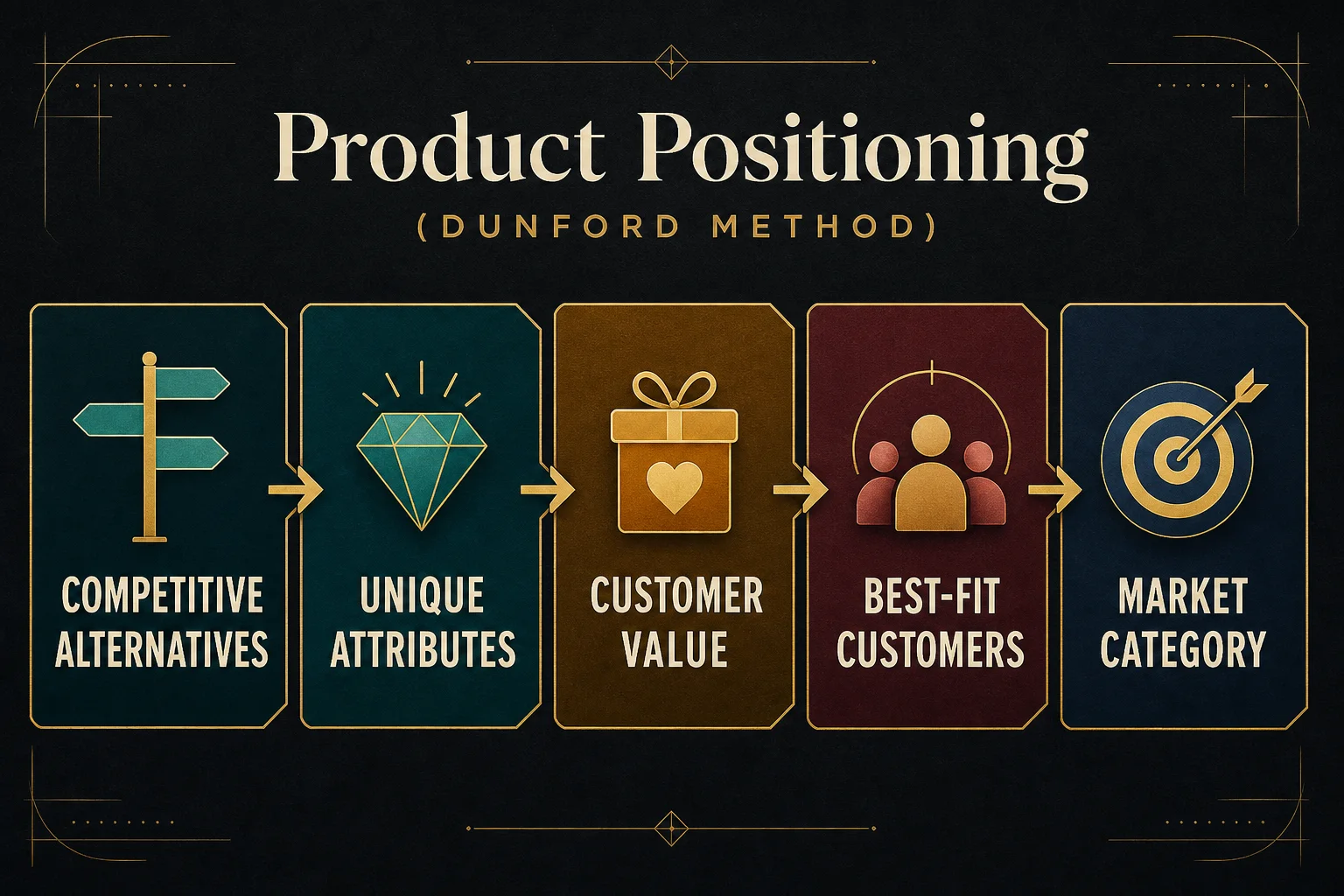
April Dunford's product-positioning method connects five components: the competitive alternatives customers would use without the product, the unique attributes it has, the value those attributes create, the customers who care most about that value and the market category that makes the value obvious. The sequence prevents teams from choosing a category or message before understanding relative customer value.
Start here: Worked product-positioning example · Original sources
Explore this guide
What is product positioning?
Product positioning defines the market context that helps a selected customer understand what a product is, why it matters and why it is a better fit than alternatives. It connects product truth to customer value and gives marketing, sales and product teams a shared basis for explaining the offer.
April Dunford's approach is especially associated with technology and business-to-business products, where capabilities can fit several categories and teams often inherit a position by accident. A product may have begun as a feature, changed its customer, expanded its capability or entered a market where the original category no longer makes its strength clear.
Positioning is not the final messaging. Messaging turns the strategic context into claims, stories, demonstrations and channel-specific language. When teams jump directly to messaging, they may polish benefits without resolving which alternatives, customers or market frame make those benefits important.
Why market context changes perceived value
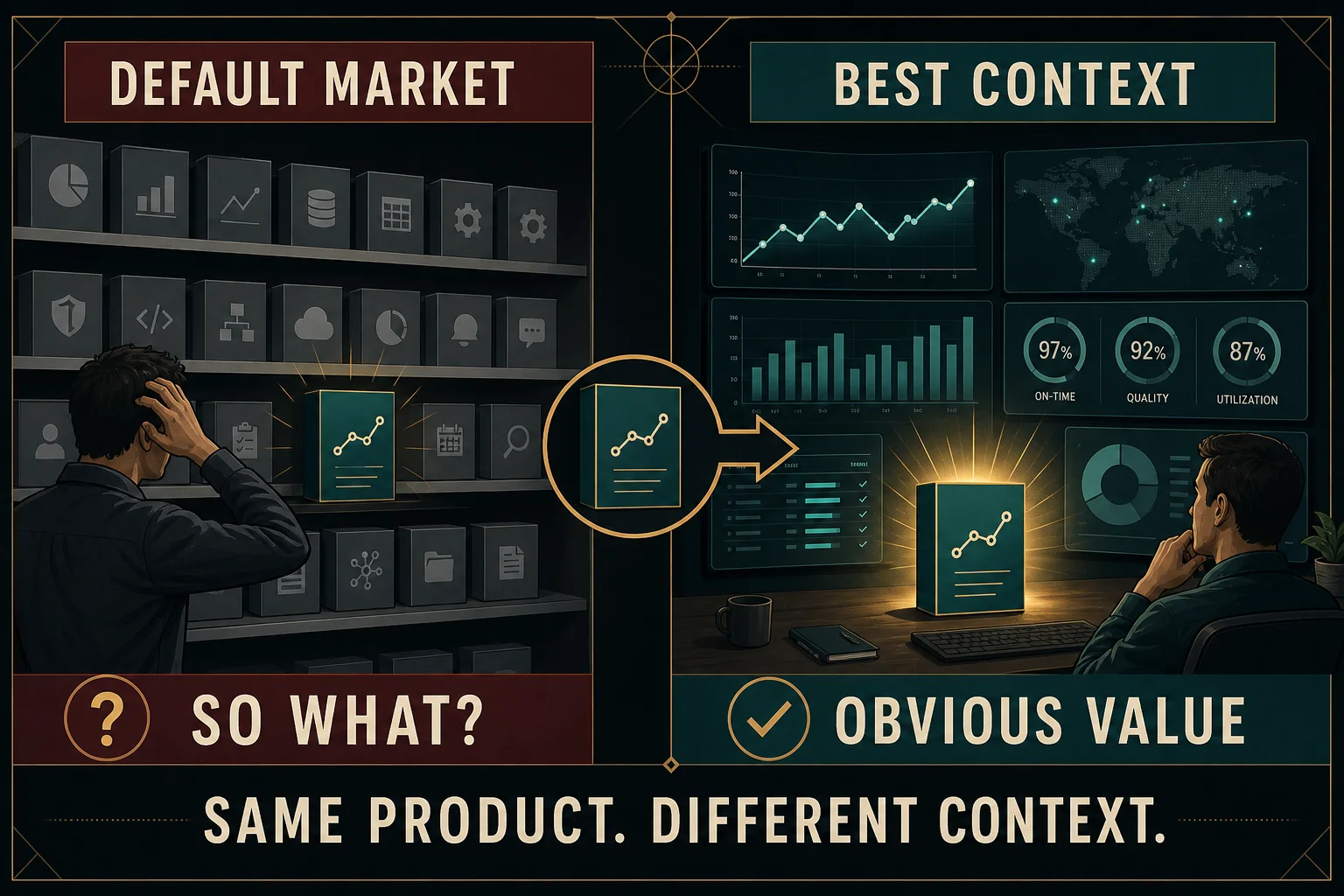
Customers use categories as shortcuts. A category suggests what a product does, who uses it, which competitors matter, what features should be present and how much it might cost. Those assumptions help people understand unfamiliar offers quickly, but a poor category can make the most differentiated capability look irrelevant.
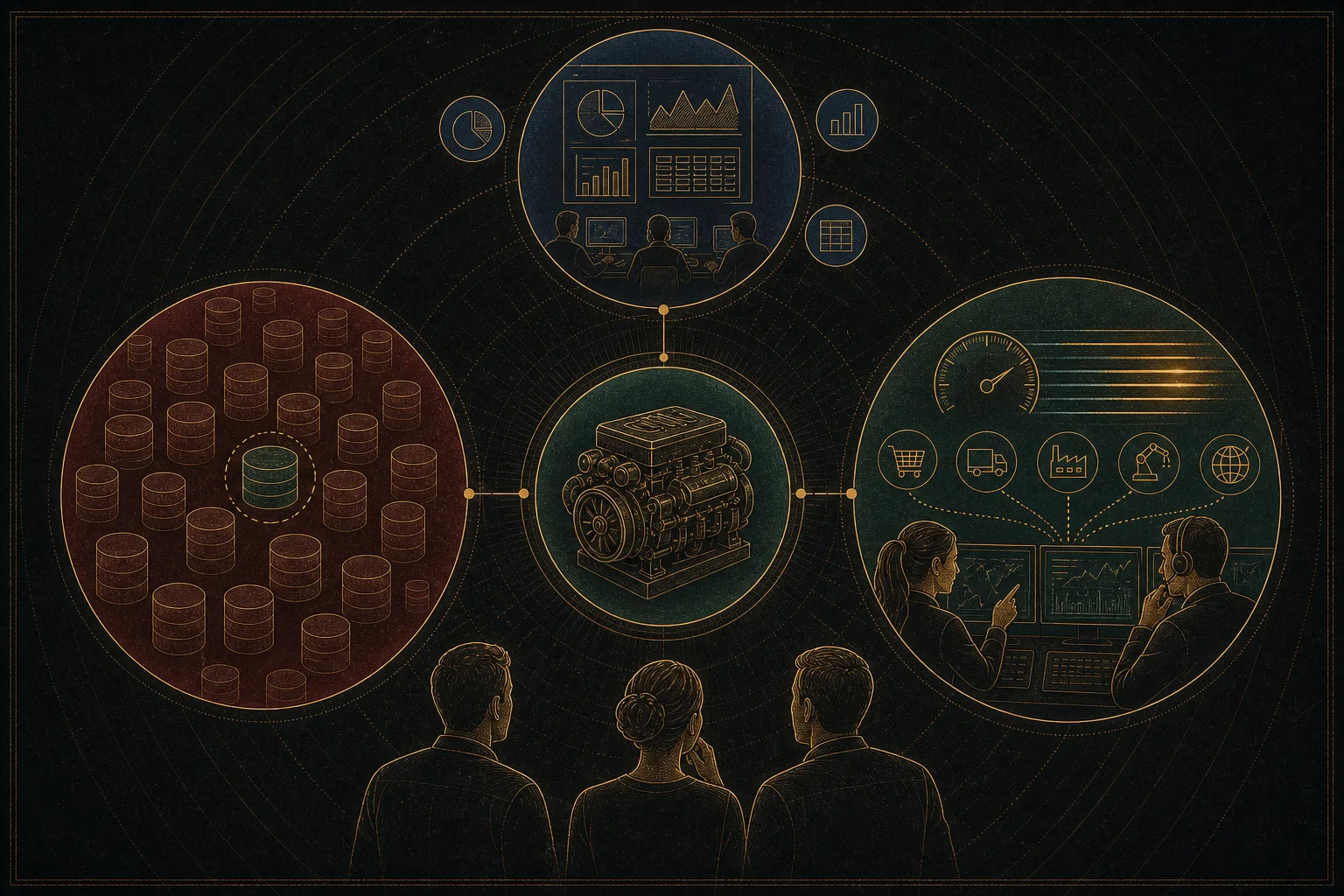
Imagine a product with automated exception explanations. In a database frame, buyers may compare storage, query speed and administration. In an operations-intelligence frame, the same capability becomes a way to detect and act on costly problems earlier. The code did not change. The comparison and value did.
A strong position does not manipulate customers into ignoring product reality. It selects the context in which the product's real strengths are most useful and credible. The product still needs the points of parity required by that context and proof that it can deliver the promised outcome.
The five components in Dunford's method
Dunford's quick-start framework uses five connected components. The order matters because each step supplies evidence for the next. Real alternatives reveal meaningful differences. Differences translate into value. Value reveals who cares most. Only then can the team select a market context that makes the value easy to understand.
Competitive alternatives
Identify what best-fit customers would use or do if the product did not exist.
- What would they buy instead?
- Would they use a manual process?
- Is doing nothing a real option?
Unique attributes
List the capabilities or characteristics the product has that the alternatives do not.
- What can only we do?
- How does our approach differ?
- Which facts are demonstrable?
Customer value
Translate differentiated attributes into outcomes customers understand and care about.
- So what does the attribute enable?
- Which pain, risk or effort changes?
- Can the outcome be observed?
Best-fit customers
Find the customers whose situation makes the differentiated value urgent and important.
- Who cares most about this value?
- What makes the pain acute?
- Which traits predict a strong fit?
Market category
Choose a context that helps best-fit customers understand the value and compare the product fairly.
- Which context makes the value obvious?
- What expectations come with it?
- Can we credibly belong and win?
Start with competitive alternatives
Ask what the best customers would do if the product did not exist. The answer is often broader than a list from a market report. A customer may use a familiar competitor, combine several tools, hire a service provider, build an internal workaround, continue with a spreadsheet or accept the problem.
Use evidence from sales calls, customer interviews and win-loss analysis. Which products appear in active deals? What process did customers replace? What happens when a deal is lost to no decision? The answers establish the reference points against which unique attributes and value must be judged.
Avoid treating every company with similar features as an equally important alternative. Positioning becomes sharper when the team understands the small set of options best-fit customers truly compare in a particular buying situation.
Move from unique attributes to customer value
Unique attributes are facts about the product or company that alternatives lack. They can include technical capability, workflow, business model, expertise, service design or data access. The list should be relative and defensible. A feature is not unique simply because the team is proud of it.
Translate each differentiated attribute by repeatedly asking so what. Continuous anomaly monitoring matters because teams do not need to watch dashboards. Rule-linked explanations matter because managers can understand the likely operational cause without waiting for an analyst. Together these capabilities create earlier action with less monitoring effort.
Cluster attributes that create the same higher-order value. A long feature list may reduce to two or three value themes such as faster action, lower implementation risk or reliable compliance. Customer evidence should reveal which themes affect purchase and which are merely pleasant additions.
Identify best-fit customers from value
Best-fit customers are not simply the largest segment. They are the customers whose context makes the differentiated value especially important. Look for characteristics that increase the pain of the current alternative or amplify the benefit of the product's unique approach.
Useful characteristics may include workflow complexity, number of locations, regulatory exposure, data volume, team structure, existing technology, growth stage or the cost of delay. The goal is to create qualification criteria that marketing can target, sales can recognize and product teams can learn from.
This step also reveals poor fits. A small operation with few exceptions may not value continuous monitoring enough to justify a specialized tool. Naming that boundary improves sales efficiency and makes the position more credible for the customers who do fit.
Choose a market category last
The category should make the differentiated value obvious to best-fit customers. An established category offers familiar language, known budget and existing demand, but it also brings expectations and competitors. A subcategory or new category may highlight difference, but it requires education and proof that the new frame deserves attention.
Evaluate whether the product meets essential points of parity, whether the category activates the right buyers and whether its comparison criteria favour the product's strengths. Also consider the cost of explaining the frame. A theoretically perfect new label may fail if customers cannot connect it to an urgent problem or purchasing process.
Market trends can provide context, but a trend is not a substitute for product value. Calling a tool AI-native may gain attention while leaving the customer unsure what outcome improves. Use trends only when they strengthen the link among differentiated capability, valuable outcome and best-fit customer.
Worked product-positioning example
The operations-intelligence example follows the method from the status quo to a focused market context. It is a hypothesis until tested through customers, sales evidence and product use, but it shows how the components build on one another.
Imagine a software product that watches live operational data, detects exceptions and explains which process needs attention. The founders call it an AI database because of its architecture, but customers do not wake up wanting another database.
Operations teams use dashboard tools, scheduled reports, spreadsheet checks and manual messages from analysts.
The product monitors changes continuously, links anomalies to operating rules and sends a plain-language explanation to the responsible team.
Teams notice costly exceptions earlier without watching dashboards or waiting for an analyst to assemble a report.
Multi-location operations teams where small delays or stock exceptions compound quickly and managers already suffer from dashboard overload.
Real-time operations intelligence, framed as an active decision layer rather than a passive database or general business-intelligence dashboard.
The context shifts attention from the product's technical architecture to the differentiated operational value. The claim still needs customer evidence and a category the company can credibly teach and support.
How to run a positioning workshop
Bring together people who know the product, customers and sales process. Product, marketing, sales, customer success and founders often hold different pieces of evidence. A facilitator should keep the group on one customer segment at a time because alternatives and value may change substantially by segment.
Prepare customer language, win-loss notes, usage patterns and competitive material before the session. Work through the five components in sequence. Capture disagreements as research questions rather than resolving every conflict through seniority or opinion.
After the workshop, validate the strongest hypotheses. Interview recent wins, losses and highly engaged customers. Test whether the competitive alternatives are accurate, whether the claimed value appears in their language and whether the proposed context improves comprehension without creating false expectations.
- One customer segment is examined at a time.
- Alternatives include the status quo and manual workarounds.
- Unique attributes are demonstrable and relative to those alternatives.
- Attributes are translated into customer outcomes.
- Best-fit characteristics explain who cares most and why.
- The category makes the value clearer and carries manageable expectations.
- Customer and sales evidence is used to validate the resulting position.
Turn positioning into messaging and sales action
Document the completed position in a shared sales narrative or positioning canvas. Include the alternatives, differentiated capabilities, value themes, best-fit criteria, category choice and evidence. Teams need the reasoning, not only a final sentence, so they can adapt without losing the strategy.
Messaging can then lead with the customer's situation and valuable outcome, explain the differentiated mechanism and show proof. Competitive pages can address specific alternatives. Sales discovery can identify the current process and best-fit characteristics. Product demonstrations can follow the value sequence rather than presenting every feature in menu order.
Positioning and messaging should also inform the roadmap. If the company promises a focused operational outcome, product priorities should strengthen that outcome and the category requirements around it. Repeated requests from poor-fit customers should not automatically pull the product away from the position.
Common product-positioning mistakes
A common mistake is selecting the category first because it appears large or fashionable. Teams then force capabilities into that frame and write generic value claims. The method reverses this order so the context follows evidence about alternatives and value.
Another mistake is treating features as value. Single sign-on, a proprietary model or real-time processing describes capability. Buyers need to understand what changes in their work, risk, cost or result. The value must remain connected to the feature so it is both relevant and credible.
The final mistake is trying to position for every possible customer at once. Different segments may use different alternatives and value the same capability for different reasons. Begin with the strongest best-fit segment. Additional segment positions can be developed deliberately when the evidence supports them.
Do not choose the market and then search for value. Trace value from the customer's real alternatives, then choose the context that reveals it.
Frequently asked questions
What are the five components of April Dunford's positioning method?
They are competitive alternatives, unique attributes, customer value, best-fit customers and market category.
Why does the method start with competitive alternatives?
Difference and value are relative. Knowing what customers would use without the product reveals which attributes are truly different and why those differences matter.
What is a competitive alternative?
It is any option the customer would use instead, including direct competitors, internal tools, spreadsheets, service providers, manual processes, doing nothing or accepting the problem.
What is the difference between positioning and messaging?
Positioning defines the customer, competitive context and differentiated value. Messaging expresses that strategy through claims, stories, proof and channel-specific language.
Should a company create a new market category?
Only when the new context makes important value clearer and the company can bear the education cost. An existing category or focused subcategory is often easier for customers to understand and buy.
Sources and further reading
- April Dunford: A Quickstart Guide to Positioning ↗The five positioning components and the relationships among alternatives, attributes, value, customers and category
- April Dunford: A Product Positioning Exercise ↗Practical guidance for working through product-positioning choices
- April Dunford: Books ↗Official information on Obviously Awesome and Sales Pitch
- Business of Software: Positioning for Growth with April Dunford ↗Talk on deliberate positioning, market context and the positioning process