
Quick answer
Positioning is the distinct and valuable place a brand, product or offer aims to occupy in a chosen customer's mind relative to alternatives. It clarifies the customer, the market frame, the difference that matters and the proof that makes the difference credible. Positioning is not merely a slogan. It is a strategic choice that should guide product, experience, pricing, distribution and communication.
Start here: Test a position against the real alternative · Worked example · Original sources
Explore this guide
Test a position against the real alternative
A positioning strategy needs a specific customer, an alternative and a difference that matters. Use this test before turning it into campaign copy.
| Draft claim | Missing decision | More useful direction |
|---|---|---|
| High-quality learning | Compared with what? | Coached practice compared with video-only study |
| Built for everyone | Who needs the difference? | Working learners preparing a live presentation |
| Personalized experience | What proves it? | Feedback on the learner’s own recorded rehearsal |
These are hypothetical directions, not ready-to-publish claims. Verify that the offer actually delivers the promised feedback and that buyers value it. Ask prospects which alternative they would use if the offer disappeared; their answer may be an existing habit, colleague or spreadsheet rather than the competitor in your presentation.
Original application worksheet for this guide. Illustrative scenarios and numbers are hypothetical. Framework origins and supporting references are listed in the sources.
What does positioning mean in marketing?
Positioning is the strategic work of defining how a brand or product should be understood by a chosen customer in relation to alternatives. It answers four connected questions: who is this for, what kind of choice is it, why is it meaningfully different, and why should anyone believe that difference?
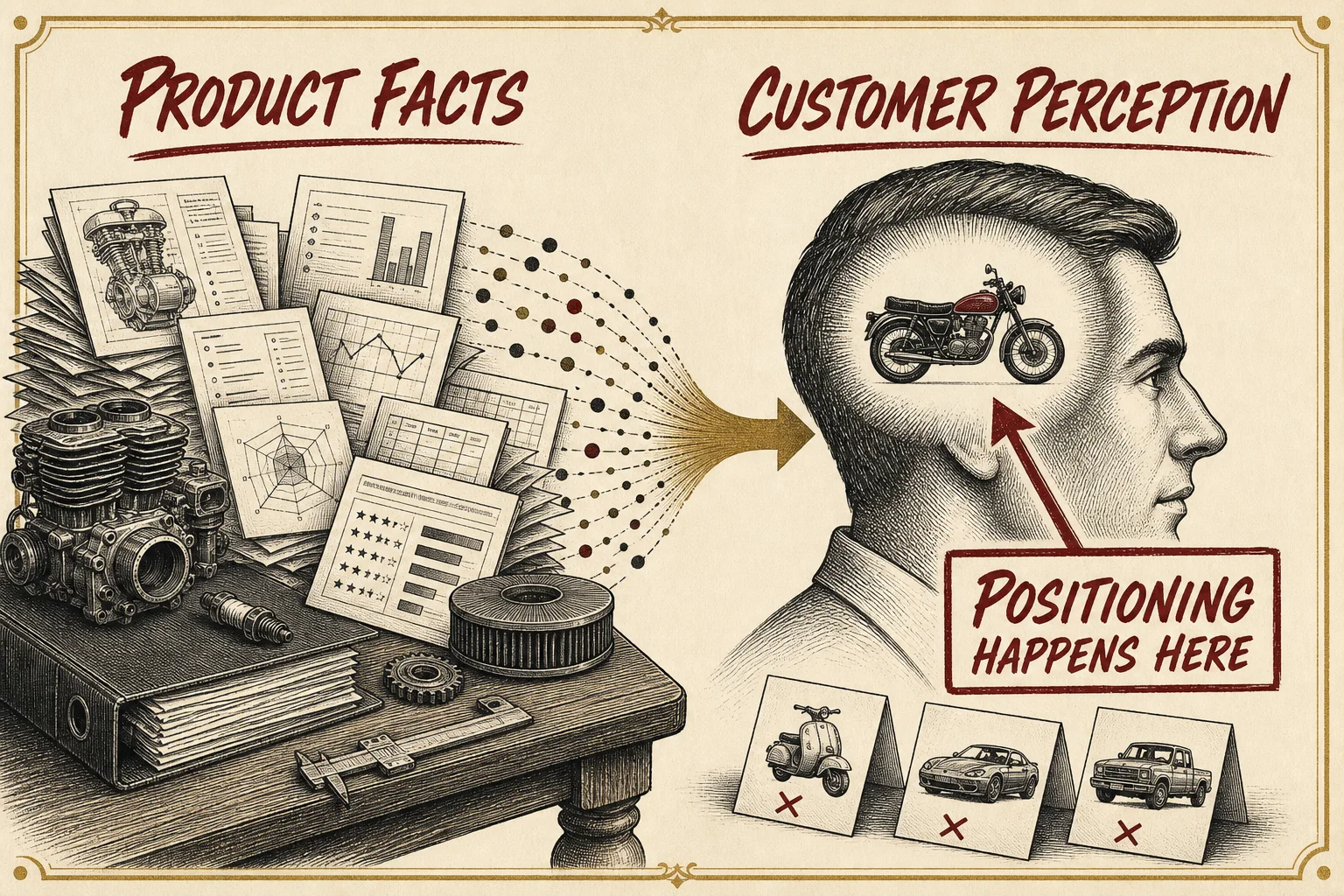
The position ultimately lives in customer perception. A company can choose its target, product design, price, category language, identity and messages, but it cannot declare the final mental result into existence. Customers interpret those signals through prior experience, category knowledge, reviews, competitors and the buying situation.
This is why positioning is larger than copywriting. A tagline can express a position, but it cannot rescue a product, price or experience that communicates something else. Strong positioning aligns the whole offer around a clear meaning customers can recognize quickly.
Where the positioning idea came from
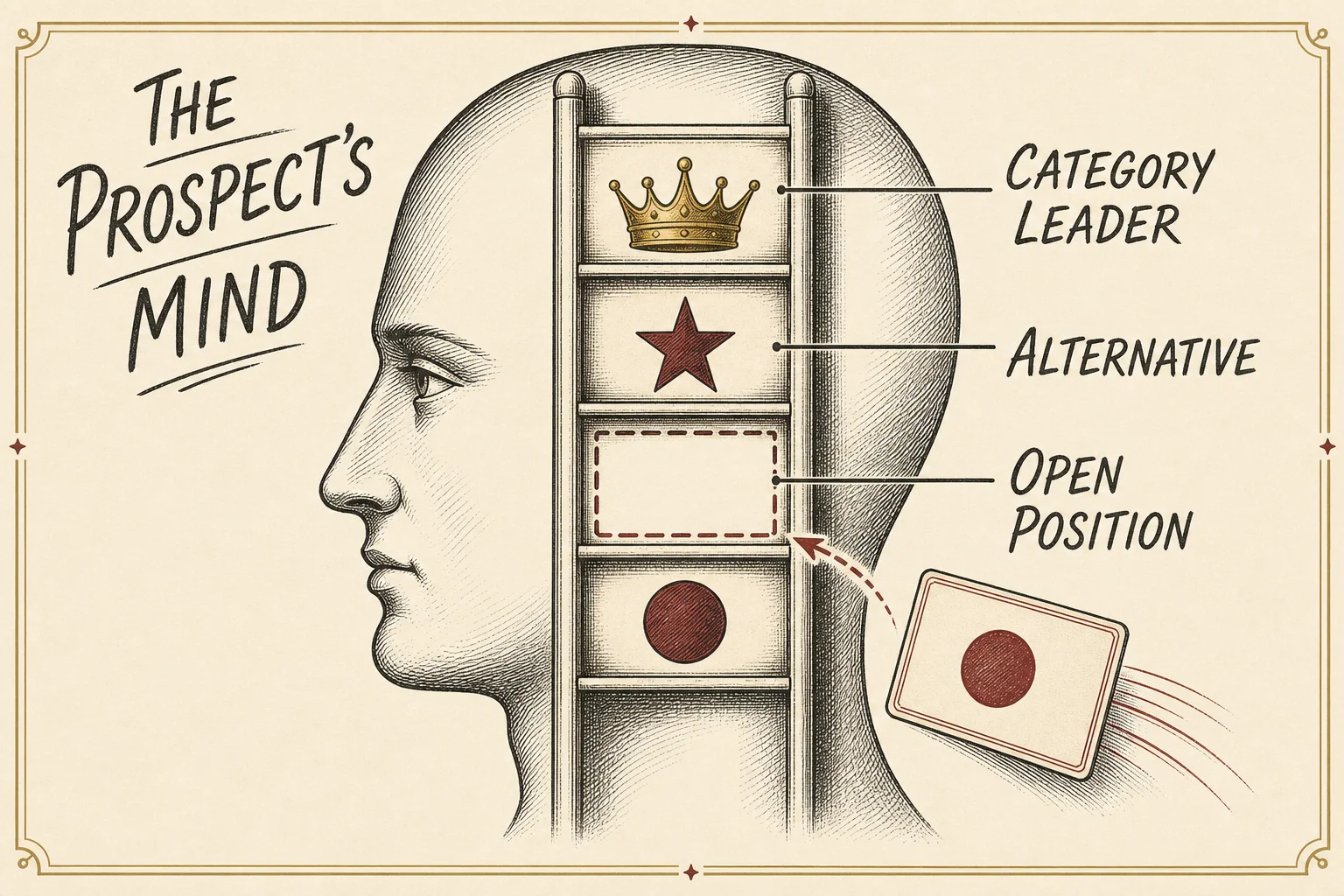
Advertising executives Al Ries and Jack Trout developed the modern language of positioning around the problem of communication in an overcommunicated society. Their 1972 Advertising Age series argued that marketers should begin with the position already present in the prospect's mind, including the positions occupied by competitors, rather than treating the mind as an empty container.
The idea changed the strategic question. Instead of asking only what to say about a product, marketers had to ask which mental category, ladder or association would make the message intelligible. A market leader might reinforce category ownership. A challenger might relate itself to the leader, create a subcategory or occupy an unclaimed attribute.
Later brand-management practice added more explicit attention to frames of reference, points of parity, points of difference and reasons to believe. Product-positioning methods have further connected these choices to competitive alternatives, differentiated capabilities, customer value and best-fit segments.
Positioning happens in the customer's mind
Customers rarely store a complete inventory of every product feature. They use compressed associations: safest, easiest, made for experts, affordable enough, built to last, the familiar leader or the specialist alternative. These shortcuts reduce decision effort but make vague positioning easy to ignore.
A perceptual position is relative. Fast only becomes meaningful when customers know what other options feel slower. Premium depends on a reference set and signals of quality. Simple may be valuable for a small team but constraining for an enterprise buyer. The same capability can create different value in different contexts.
Marketers should therefore research both desired meaning and present perception. Interviews, review analysis, search behaviour, win-loss conversations and perceptual mapping can reveal the alternatives customers consider, the language they use and the attributes on which brands are actually compared.
A practical positioning process
Positioning is best developed as a sequence of choices, not a wordsmithing exercise. Begin with evidence about the customer and competitive set. Then connect what the organization can uniquely deliver to what a selected group values. The final language should summarize resolved strategy rather than conceal unresolved debate.
Choose the customer
Define the group and buying situation for which the position must be especially relevant.
- Whose decision matters most?
- What triggers the choice?
- Which needs or constraints shape it?
Set the frame
Name the category or set of alternatives customers will use to understand and judge the offer.
- What would customers use instead?
- Which category creates useful expectations?
- What must be true to belong?
Find the valued difference
Select a distinctive benefit or association that matters in the chosen decision.
- What can we deliver unusually well?
- Why would the customer care?
- Can competitors claim the same thing?
Establish proof
Connect the desired difference to reasons customers can see, test or trust.
- What makes the promise credible?
- Which product truth creates the benefit?
- Can the experience demonstrate it?
Align every signal
Express the position consistently through the whole market experience, then measure perception.
- Do product and price support the meaning?
- Are messages mutually reinforcing?
- What do customers actually associate with us?
Balance points of parity and points of difference
A brand must be different enough to deserve attention and familiar enough to be understood as a valid choice. Points of parity are the attributes or benefits customers regard as necessary to belong in the frame of reference. A hotel positioned around remarkable local design still needs credible cleanliness and security. A new analytics product still needs reliable data handling.
Points of difference are the associations customers should strongly connect with the brand and value relative to alternatives. The strongest differences are desirable to the customer, deliverable by the organization and distinguishable in the market. A claim that matters but cannot be proven is fragile. A capability competitors lack but customers do not value is not useful positioning.
Trade-offs can make a position more believable. A tool designed for speed and ease may deliberately offer fewer advanced controls. A specialist service may cost more because senior expertise is directly involved. Refusing every trade-off usually produces an undifferentiated promise to be best for everyone.
Positioning example: a repairable commuter backpack
The example below shows how a broad product truth becomes a focused market meaning. The choices should be tested with customers, but they give product, retail and communication teams a common direction.
Imagine a company launching a repairable commuter backpack. The market already contains inexpensive everyday bags, technical outdoor packs and premium fashion bags. Calling the new product high quality would add another generic claim to a crowded field.
Daily urban commuters who carry a laptop and have already replaced a bag because one zip, buckle or strap failed.
A dependable everyday commuter backpack, not specialist hiking equipment or a luxury fashion accessory.
The practical backpack designed so one worn component does not end the whole bag.
Replaceable zip and buckle modules, reinforced stress points, a repair service and a visible parts guide.
Show the repair mechanism on the product page, price the service clearly, train retail staff and build launch communication around useful longevity.
The position is not simply sustainable backpack. It connects a specific frustration, an understandable category, a useful difference and evidence the customer can inspect.
How to activate a position
Translate the position into decisions across the marketing mix. Product priorities should create the promised value. Price should make sense for the frame and quality signal. Distribution should place the offer where the chosen customer expects to find or evaluate it. Service policies should reinforce the reason to believe.
Brand identity and communication then make the strategy easier to notice and remember. Use category cues when customers need quick orientation, and distinctive assets when recognition matters. Messages can vary by channel and funnel stage while reinforcing the same central value and proof.
Sales enablement is part of activation. Teams need to recognize best-fit customers, explain the competitive frame and connect capabilities to outcomes. If the website describes one position while sales pitches every possible benefit, the market receives a blurred signal.
- A clearly defined customer and decision situation
- A frame of reference customers already understand or can learn
- Points of parity that establish category credibility
- One primary difference that creates relevant customer value
- Visible and defensible reasons to believe
- Product, price, channel, identity, messaging and sales signals that agree
- Research that measures actual perception, not only message recall
Common positioning mistakes
The first mistake is treating positioning as a positive description. Innovative, customer-centric, high quality and trusted may sound attractive, but they rarely specify a customer, competitive frame or meaningful difference. If any serious competitor can use the sentence unchanged, it is not yet a position.
The second mistake is beginning with the company rather than the customer's alternatives. A team may think it competes with similar products while customers compare the purchase with a spreadsheet, an agency, a manual process or doing nothing. The wrong competitive set produces the wrong value argument.
The third mistake is confusing aspiration with evidence. Repositioning can lead future change, but the organization must build the capabilities and experiences that support it. Repetition alone cannot sustainably attach a promise that customers repeatedly find untrue.
Positioning is the meaning customers retain, not the number of claims a company releases.
How to know whether the position is working
Measure both mental and commercial effects. Qualitative research can test whether customers understand the frame, repeat the intended association and find the proof credible. Quantitative brand tracking can compare awareness, consideration, attribute association and preference among the intended segment.
Behavioural evidence includes changes in qualified demand, conversion, win rate, price realization, retention and the reasons customers give for choosing or rejecting the offer. Results should be segmented because a sharper position may improve relevance for best-fit customers while intentionally becoming less appealing to others.
Do not change the position whenever a campaign underperforms. First distinguish a strategy problem from weak reach, execution, offer, experience or measurement. Reposition when the customer, market frame, competition or organization's capabilities have materially changed, or when evidence shows the desired meaning is no longer relevant or defensible.
Frequently asked questions
What is positioning in simple words?
Positioning is the clear place you want a product or brand to occupy in a chosen customer's mind compared with other ways of solving the same problem.
What are the main elements of positioning?
The main elements are the target customer, frame of reference or competitive alternatives, meaningful point of difference, customer value and credible reasons to believe.
Is positioning the same as a tagline?
No. Positioning is an internal strategic choice that guides the offer and its signals. A tagline is one possible public expression of that choice.
What is the difference between positioning and value proposition?
Positioning defines how the offer should be understood relative to alternatives for a selected customer. A value proposition explains the value that customer can expect. They overlap, but positioning adds an explicit competitive and category context.
When should a brand reposition?
Repositioning is appropriate when customer needs, competitive alternatives, category meaning or the organization's capabilities have changed enough that the current position is no longer relevant, clear or credible.
Sources and further reading
- Al Ries: The Original Positioning Articles ↗The 1972 Advertising Age series on positioning in an overcommunicated society
- RIES: History of Positioning ↗Background on the development and publication history of the positioning concept
- Harvard Business Review: Three Questions You Need to Ask About Your Brand ↗Kevin Lane Keller and colleagues on frame of reference, points of parity and points of difference
- Cornell: How to Write Market Positioning Statements ↗Practical guidance on target market, category, differentiation and reasons to believe
Explore related concepts
Discuss an application
Use the worksheet and example to define your decision first. For a project collaboration, contact Rishabh Vats with your objective, context and the evidence you already have.