
Quick answer
A brand positioning statement is a concise internal articulation of the target customer, frame of reference, meaningful point of difference and reason to believe. A common structure is: For the target, the brand is the frame of reference that delivers the point of difference because of the reason to believe. The statement aligns decisions; it is not usually public-facing copy.
Start here: Repair a vague positioning statement · Worked example · Original sources
Explore this guide
Repair a vague positioning statement
A useful positioning statement template connects target, category, benefit and proof. Use this before writing a public tagline.
| Component | Weak draft | Hypothetical repair |
|---|---|---|
| Target | For modern businesses | For regional service teams coordinating repeat visits |
| Frame | An innovative platform | A shared scheduling workspace |
| Difference | That makes work easier | That keeps visit changes and customer updates together |
| Proof | With world-class technology | Through a shared change log and tested notification workflow |
Combine the repaired cells into one internal statement, then check each against research and product reality. The example is invented: a shared log is proof only if it exists and reliably delivers the benefit. A tagline can be shorter and more expressive; the internal statement must remain specific enough to guide product, sales and messaging decisions.
Original application worksheet for this guide. Illustrative scenarios and numbers are hypothetical. Framework origins and supporting references are listed in the sources.
What is a brand positioning statement?
A brand positioning statement is a concise internal summary of how a brand intends to create a distinct and credible place in the market. It defines the priority customer, the frame in which the brand should be understood, the value that makes it meaningfully different and the evidence supporting that value.
The statement is a decision filter. Product teams can ask whether a feature strengthens the promised benefit. Brand teams can judge whether identity and experiences express the intended meaning. Marketing and sales teams can adapt messages for different contexts without drifting into unrelated claims.
A positioning statement is not a mission, vision, purpose, tagline or elevator pitch. Those artifacts can be informed by positioning, but they serve different audiences and jobs. The statement may sound plain because precision and alignment matter more than public-facing style.
The four components of a positioning statement
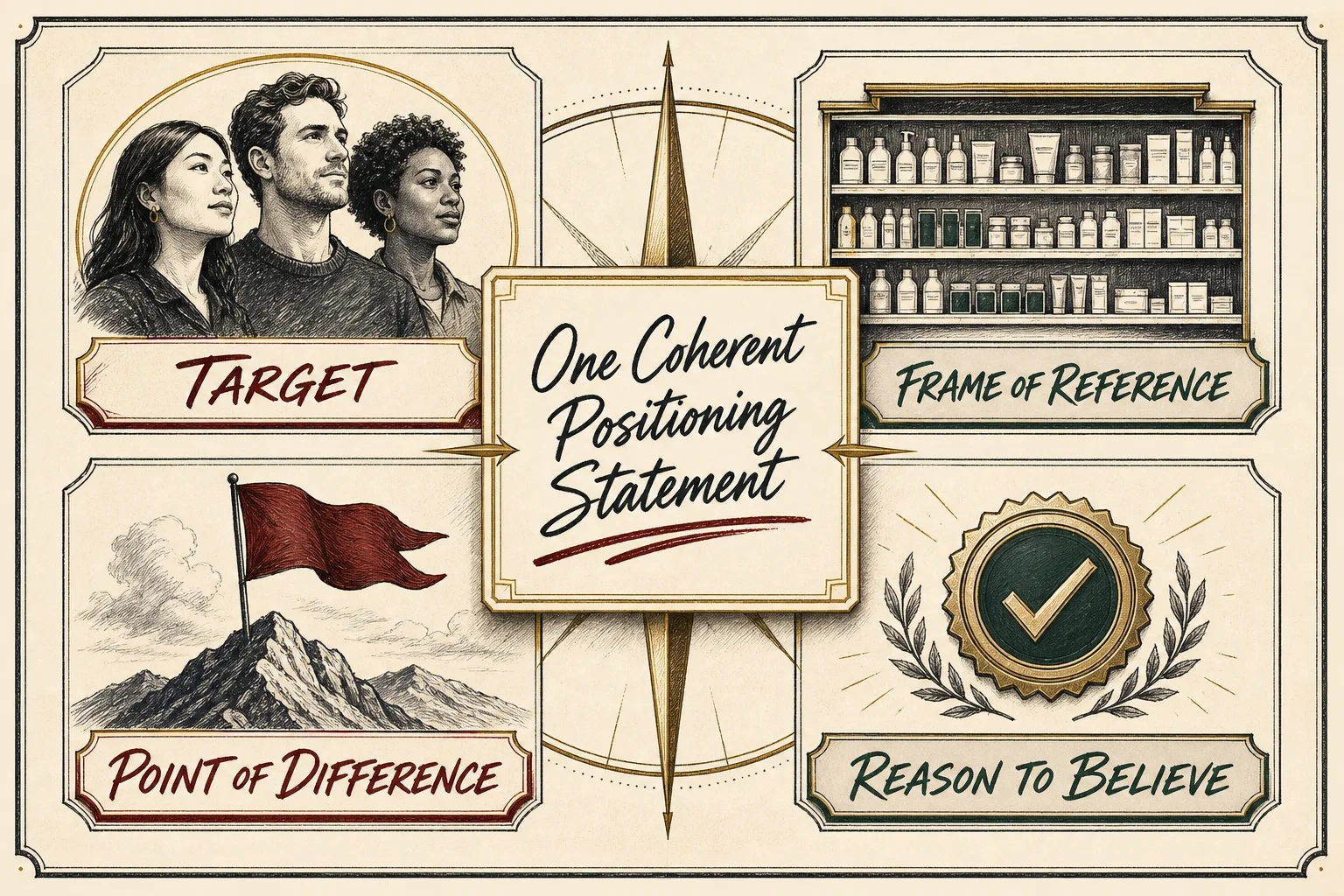
Widely used positioning frameworks identify four connected elements: a target, a frame of reference, a point of difference and a reason to believe. Some versions add the underlying customer need or desired outcome explicitly. Others express customer value separately. The strategic logic remains similar.
The components should not be completed independently by four teams and joined at the end. The target affects which alternatives matter. The frame affects which benefits count as different. The point of difference determines what proof is necessary. Writing exposes whether those choices actually fit together.
Target
Identify the priority customer and the need or situation that makes the choice relevant.
- Who must find this especially valuable?
- What are they trying to accomplish?
- What defines the buying situation?
Frame of reference
Define the category or competitive context that tells customers what the brand is and how to judge it.
- What alternatives enter the decision?
- Which category expectations must we meet?
- What context makes our value clearest?
Point of difference
Choose the benefit or association customers should value and connect more strongly with this brand.
- What meaningful value is distinctive?
- Is the choice relative to real alternatives?
- Does it require a trade-off?
Reason to believe
Show why the brand can credibly and consistently deliver the promised difference.
- Which capability creates the benefit?
- What can customers verify?
- Does the experience support the claim?
Define a target that improves the decision
A target should identify the people for whom the position has unusually high relevance, not simply describe the brand's total addressable market. Useful targets combine a recognizable group with a situation, need, behaviour or constraint that changes what they value.
Demographics may help when age, life stage, income or location genuinely shapes the choice. In many categories, behavioural and situational variables are more actionable: first-time team leaders replacing spreadsheets, frequent travellers carrying fragile equipment or commuters who have experienced repeated bag failure.
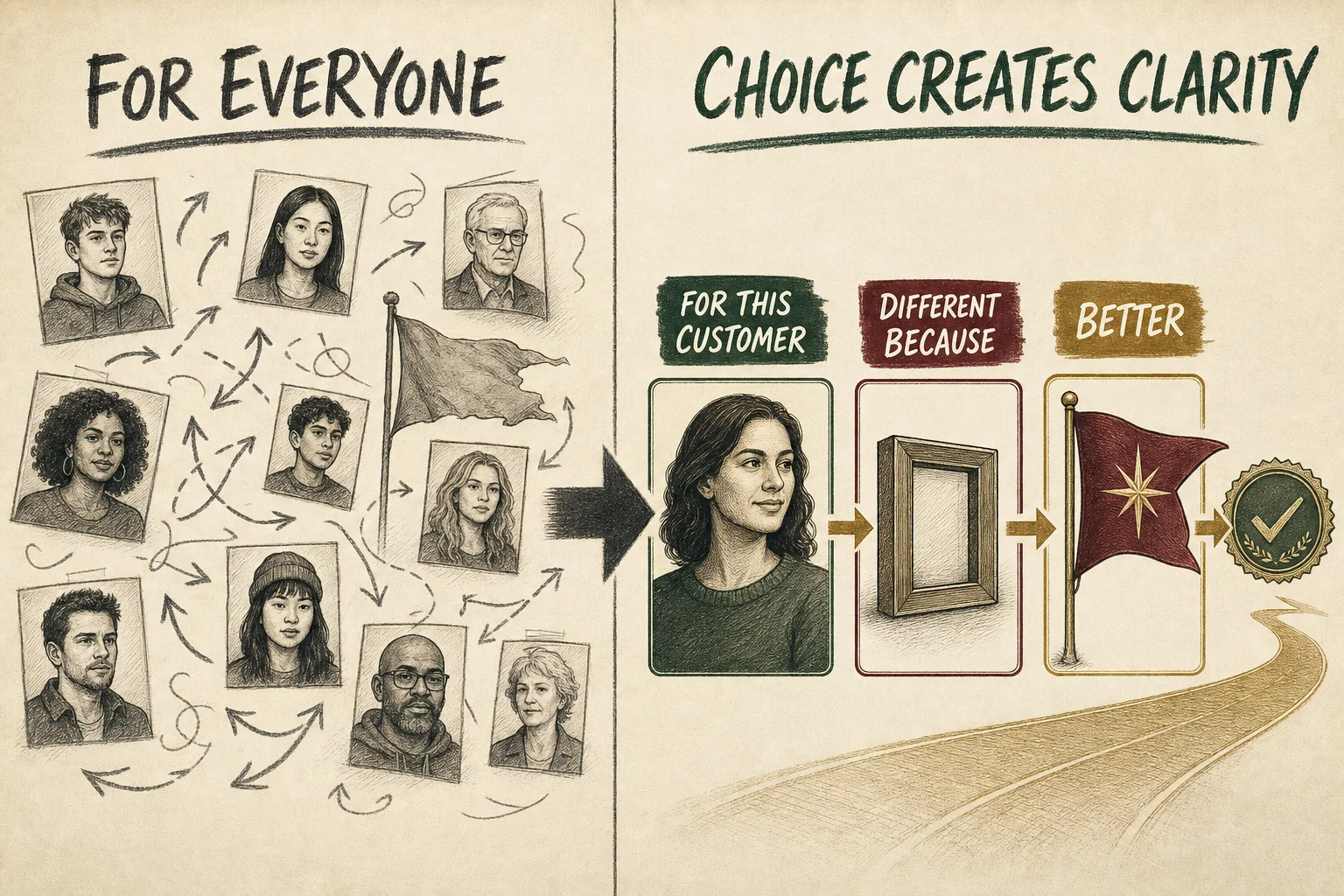
The statement does not need to exclude every adjacent buyer. It needs to prioritize. A clear primary customer allows the organization to design stronger value and communication. If the target reads everyone who wants quality, it has avoided the strategic choice.
Choose the right frame of reference
The frame of reference tells people what kind of solution the brand is and which expectations apply. It can be a conventional product category, a use occasion, a competitive set or another understandable market context. Without a frame, difference floats without a basis for comparison.
A frame creates points of parity. These are the attributes or benefits a brand must credibly deliver to be accepted as a legitimate member of the category. An online bank may differentiate on simplicity but must still signal security. A premium running shoe may emphasize energy return but must still provide expected fit and durability.
Frames are strategic because they alter the value of capabilities. The same software can appear like a minor reporting feature inside a broad database category or like an essential decision tool inside an operations-analytics category. Choose the frame customers can understand and the brand can credibly win.
Connect the point of difference to proof
A point of difference is the benefit or association the target should value and link strongly with the brand. It should be important enough to affect choice, distinctive enough to separate the offer and deliverable enough to survive real experience.
Avoid building the statement around adjectives such as better, innovative, premium or customer-centric. These words do not explain better for whom, on which dimension or because of what. Translate capability into customer value: automated reconciliation is a feature; closing the monthly books without hunting through five spreadsheets is a value.
The reason to believe closes the credibility gap. It may be a product mechanism, specialist expertise, proprietary process, demonstrated result, ingredient, service model, history or customer evidence. Strong proof is specific enough to inspect and closely connected to the promised benefit.
Brand positioning statement template
A practical first draft is: For [target in a relevant situation], [brand] is the [frame of reference] that [point of difference], because [reason to believe]. The grammar is less important than the logic. Use the template to expose choices, then rewrite for clarity without removing the strategic content.
Add a customer need if the point of difference lacks context: For [target] who [need or tension], [brand] is the [frame] that [benefit] because [proof]. If teams use the statement internationally or across several products, document what each phrase means so local adaptation does not quietly change the strategy.
Keep the internal statement to one focused paragraph. Research, competitor analysis and rationale belong in a supporting positioning document. The statement should be short enough to remember but complete enough to prevent contradictory interpretation.
- For [priority target]
- who [need, problem or decision situation],
- [brand] is the [frame of reference]
- that [meaningful point of difference]
- because [specific reason to believe].
Brand positioning statement example
The repairable-backpack example shows each component separately before combining it. This makes assumptions visible and gives teams a chance to challenge the target, frame, difference or proof rather than debating sentence style.
Consider a repairable commuter-backpack brand. The product team has multiple positive facts: durable fabric, modular components, clean design and a repair service. The statement must choose which customer and value those facts should organize around.
For daily urban commuters who carry a laptop and are frustrated when one failed part makes an otherwise useful bag disposable
our brand is the dependable everyday commuter backpack
that keeps small failures from ending the whole bag
because its high-wear components can be replaced and are supported by a visible repair service.
Combined statement: For daily urban commuters who are frustrated by premature bag failure, our brand is the dependable everyday commuter backpack that keeps small failures from ending the whole bag because high-wear components can be replaced through a visible repair system.
How to write the statement with a team
Begin with evidence, not a blank template. Gather customer interviews, reviews, search language, usage data, win-loss notes, competitive claims and product capabilities. Identify the alternatives customers actually consider, including manual processes, substitutes and doing nothing.
Draft several strategic routes. One route may prioritize ease, another specialist performance and another ownership cost. For each, specify the target, frame, difference and proof. Compare the routes against customer relevance, competitive distinctiveness, organizational capability and long-term usefulness.
Make a decision with the people who own product, commercial and brand outcomes. Then test comprehension and credibility with customers. The goal is not to ask respondents to approve the sentence. It is to learn whether the intended frame and value make sense and whether the proof changes belief.
- The target is a priority, not a description of everyone who could buy.
- The frame matches the alternatives customers actually consider.
- Required points of parity are understood.
- The point of difference describes customer value, not only a feature.
- The reason to believe directly supports the difference.
- The full statement makes one coherent strategic choice.
- Product, brand, sales and leadership can use it to make decisions.
Turn the statement into a working brand system
Translate the statement into a positioning platform with audience evidence, category rules, value pillars, proof, personality, message priorities and examples of what the brand will not claim. This prevents the single sentence from carrying more detail than it can hold.
Use the platform to write channel-specific messaging. An advertisement may dramatize the difference emotionally. A product page may explain the mechanism. A sales deck may compare alternatives and proof. The words can change while the frame and value remain consistent.
Review major product, partnership, pricing and campaign choices against the statement. If every proposal can be justified equally, the statement is too broad. If teams repeatedly need to ignore it to serve the intended customer, the strategy or its evidence needs revision.
Common positioning statement mistakes
The most common mistake is writing for everyone. Fear of excluding possible buyers produces a generic target, a broad frame and a list of benefits. The result may be factually inclusive but strategically powerless.
Another mistake is using internal language customers would never recognize. Proprietary category names and abstract corporate claims can make a statement appear distinctive while hiding the competitive context. Start with the customer's language and add new framing only when the organization can teach it.
A third mistake is putting the slogan into the strategy. A polished phrase can disguise missing proof or an unclear target. Complete the logic in ordinary language first. Creative expression should make a strong strategy memorable, not make an unresolved strategy sound finished.
A useful positioning statement creates productive exclusions. It tells the organization which choices belong and which do not.
Frequently asked questions
What is a brand positioning statement?
It is an internal strategic statement defining the priority target, frame of reference, meaningful point of difference and reason the difference is credible.
What is the standard positioning statement template?
A common template is: For the target, the brand is the frame of reference that delivers the point of difference because of the reason to believe.
Is a positioning statement the same as a tagline?
No. A positioning statement aligns internal decisions and contains strategic detail. A tagline is short public-facing language that may express one aspect of the position.
How long should a positioning statement be?
Usually one focused sentence or short paragraph. It should be memorable enough to use and complete enough to include the target, frame, difference and proof.
Who should write a brand positioning statement?
A strategist or brand lead may facilitate the work, but product, customer, commercial and leadership owners should contribute evidence and agree on the final strategic choices.
Sources and further reading
- Cornell: How to Write Market Positioning Statements ↗Guidance on target market, brand, differentiation, frame of reference and reasons to believe
- Kellogg on Branding in a Hyper-Connected World: Positioning excerpt ↗Brand-positioning framework covering target, frame, point of difference and reason to believe
- Harvard Business Review: Three Questions You Need to Ask About Your Brand ↗Kevin Lane Keller and colleagues on competitive frame, points of parity and points of difference
- Al Ries: The Original Positioning Articles ↗Foundational articles on establishing a position in the prospect's mind
Explore related concepts
Discuss an application
Use the worksheet and example to define your decision first. For a project collaboration, contact Rishabh Vats with your objective, context and the evidence you already have.