Quick answer
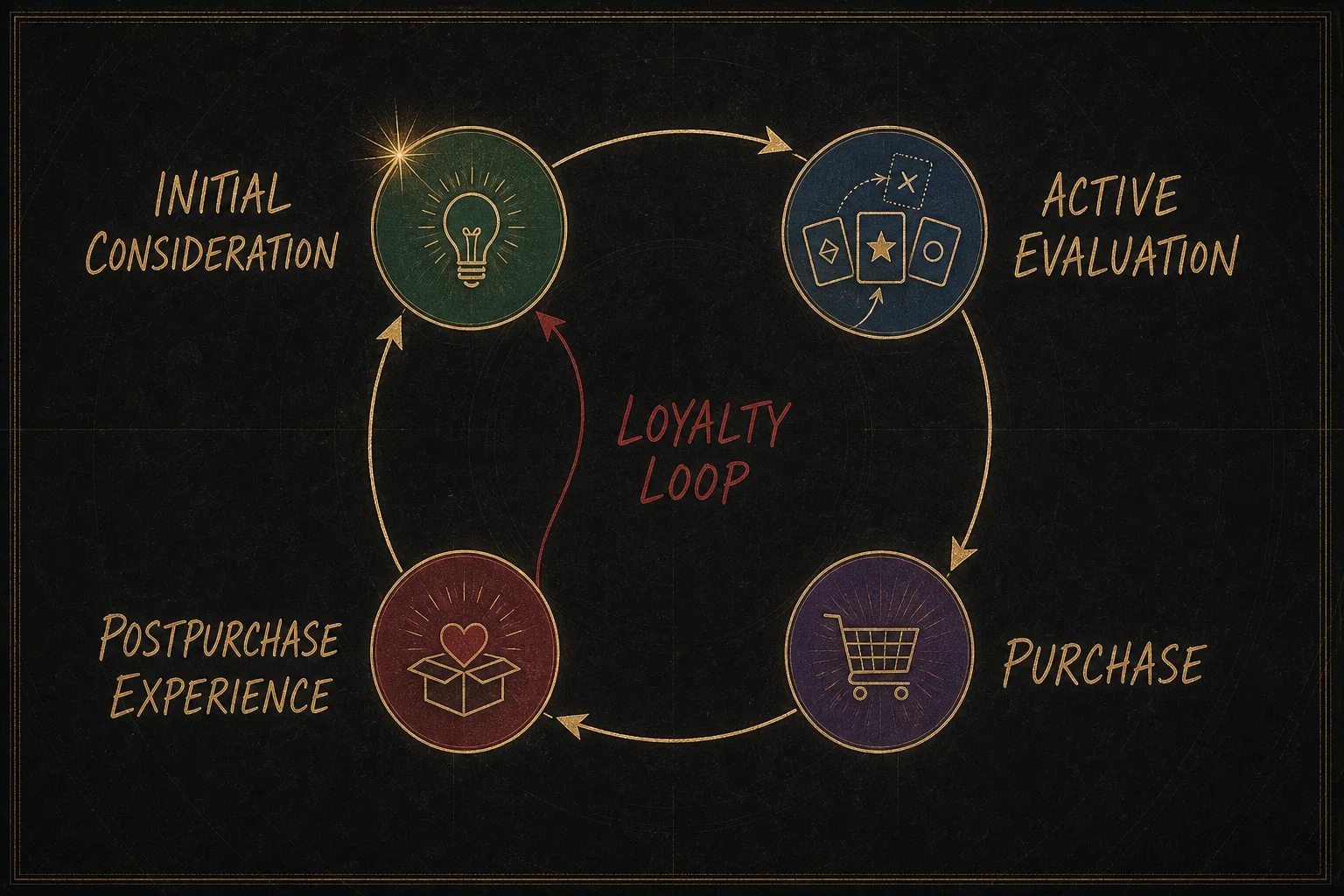
The Consumer Decision Journey is a circular model introduced by McKinsey in 2009. It describes four broad phases: initial consideration, active evaluation, purchase and post-purchase experience. Buyers can add or remove brands during evaluation, and a strong experience can create a loyalty loop that shapes the next decision before a fresh search begins.
How to map complex decision journeys
Complex decision journeys contain loops, pauses, added alternatives and sometimes several decision-makers. Keep McKinsey's four stages as a useful structure, but record observed movements rather than forcing every buyer through a straight line.
| What to capture | Example research question | Useful evidence |
|---|---|---|
| Trigger and initial options | What changed, and which options came to mind first? | Recent-buyer interviews and unaided recall |
| Evaluation loops | What made you add, remove or revisit an option? | Decision diaries, search behaviour and interview timelines |
| People and handoffs | Who influenced the choice, approved it or could stop it? | Role interviews and buying-committee maps |
| Purchase barriers | What nearly stopped the decision at the final step? | Abandonment research, availability and service records |
| Experience and next decision | What would make you repeat the purchase or reopen the search? | Follow-up interviews, support issues and repeat behaviour |
Separate the descriptive map from attribution. A touchpoint appearing in an interview or analytics path does not prove that it caused purchase. Prioritise a specific friction, test a change where feasible and compare the relevant outcome.
For multiple stakeholders, pair this map with buying-committee mapping. For the broader experience across service and use, compare customer journey mapping.
Start here: A practical decision journey example · Original sources
Explore this guide
What is the Consumer Decision Journey?
The Consumer Decision Journey is a model of how buyers move from a need trigger through evaluation, purchase and experience. McKinsey introduced the model in 2009 after research into purchase decisions across several industries and markets.
Its central challenge to the traditional funnel is simple. Buyers do not only begin with many brands and methodically remove them. During active evaluation they can discover and add brands, change criteria, consult other people, switch between online and offline channels, delay the decision and return with new information.
The model therefore treats the decision as a cycle rather than a one-way descent. Post-purchase experience is not the end. It changes expectations, word of mouth and the set of options considered when the category need returns.
Where the model came from
McKinsey's 2009 article reported research into almost 20,000 consumers across five industries and three continents. The researchers argued that expanding media, product choice and consumer-controlled information made the traditional funnel too simple for planning influence.
The work identified four broad moments where marketers could win or lose: initial consideration, active evaluation, closure at purchase and post-purchase experience. It also distinguished passive loyalty, where customers stay but remain open to alternatives, from active loyalty, where they prefer and advocate for a brand.
Later customer-journey research widened the lens further. Katherine Lemon and Peter Verhoef described experiences across multiple touchpoints, channels, media, social influences and time. Google's messy-middle research focused on repeated exploration and evaluation within abundant digital choice. These models differ, but all warn against treating a diagram as a literal sequence followed by every person.
The four stages and the loyalty loop
The four stages are not campaign phases owned by separate channels. They are changing decision states. A search result, a friend, a salesperson or product usage can influence more than one state depending on the buyer and context.
Initial consideration
A trigger activates a category need and a first set of brands or solutions comes to mind.
- What creates the need now?
- Which options enter memory first?
- Which recent touchpoints shape that first set?
Active evaluation
The buyer searches, compares and changes the option set as new information appears.
- Where do buyers gather evidence?
- What adds us to the set?
- What causes removal or delay?
Purchase
The buyer selects an option at a moment where availability, confidence and friction still matter.
- What closes the decision?
- What can still change the choice?
- Can the preferred option be obtained easily?
Post-purchase experience
Use of the product confirms, weakens or changes expectations and shapes the next decision.
- Does the experience deliver the promise?
- What creates active loyalty?
- What will the customer tell others?
The most important idea: the consideration set can expand
A funnel encourages teams to think mainly about keeping people from dropping out. The decision journey adds a different opportunity: a brand that was absent at the start can enter during active evaluation.
That can happen when a category search reveals a specialist, a comparison explains an overlooked difference, a review supplies confidence, a retailer recommends a new option or a friend reframes the decision. For challengers, this means initial awareness is not the only route to growth. Being useful and credible at an evaluation moment can create entry.
For established brands, initial consideration is valuable but not permanent. A familiar option can be removed when information is weak, reviews expose a mismatch, availability fails or a competitor communicates a more relevant advantage.
- Identify the questions that create new options during evaluation.
- Find the comparison criteria that remove otherwise familiar brands.
- Make evidence available where buyers actually research.
- Equip sales, retail and service touchpoints with the same truthful differentiation.
- Track additions and removals, not only final preference.
A practical decision journey example
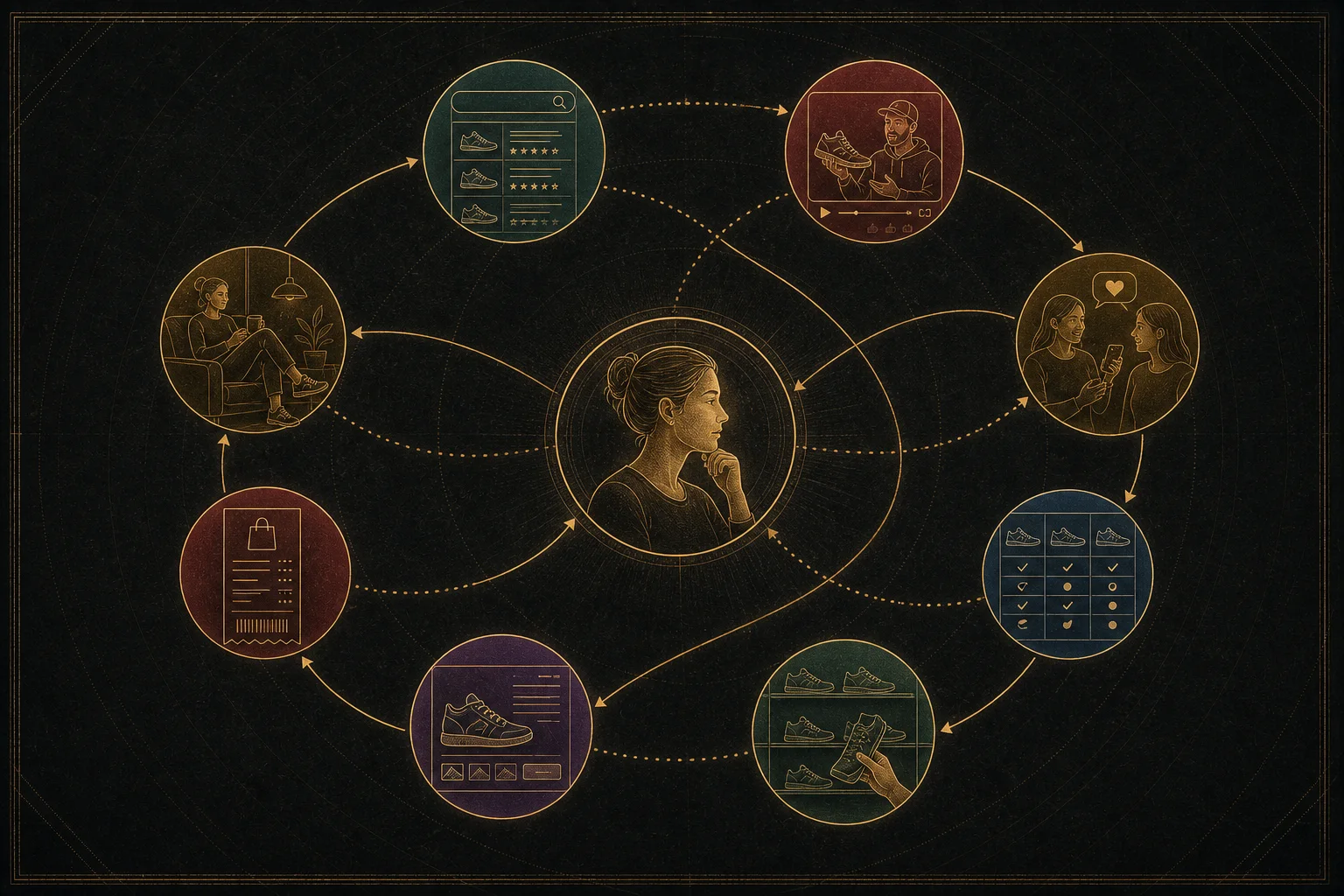
The running-shoe example shows why a journey map should record the changing option set and the evidence used at each moment, not just a row of channels.
Imagine a buyer choosing running shoes after discomfort during a weekend run. The trigger is personal and immediate, but the option set changes repeatedly before purchase.
Three familiar brands come to mind from past use, a friend's shoes and recent sports advertising.
The buyer searches by foot type, watches fitting videos, reads reviews, visits a store and adds two unfamiliar specialist brands while removing one familiar option.
Fit, availability, return policy and a helpful in-store explanation turn one shortlisted shoe into the final choice.
Several comfortable runs confirm the decision. The buyer recommends the shoe and starts the next replacement journey with the brand already favoured.
A funnel can record awareness, product views and purchase. The journey explains why a new brand entered midway, why another disappeared and how product experience changes the next consideration set.
How to map a real consumer decision journey
Choose one audience, one decision and one context. A journey for a first-time buyer is different from a renewal journey, and a low-risk repeat purchase is different from a high-consideration contract. Avoid one universal map labelled for everyone.
Interview recent buyers and non-buyers close to the decision. Ask what triggered the need, which options came to mind first, what they added or removed, where they looked, which people influenced them, what almost stopped the purchase and how the experience compared with expectations. Support recall with search, analytics, sales, service and product evidence.
On the map, separate customer actions, questions, feelings, touchpoints and evidence. Mark moments that change the option set or reduce uncertainty. Then connect each priority moment to an owner, a customer need, an improvement and a measurable outcome.
- One defined audience, decision and situation
- A clear trigger and initial consideration set
- Options added and removed during evaluation
- Customer-controlled, company-controlled and social touchpoints
- Questions, uncertainty and decision criteria
- The purchase moment and remaining friction
- Product experience, loyalty and word-of-mouth effects
- Owners and measures for the moments that matter
Consumer decision journey versus purchase funnel
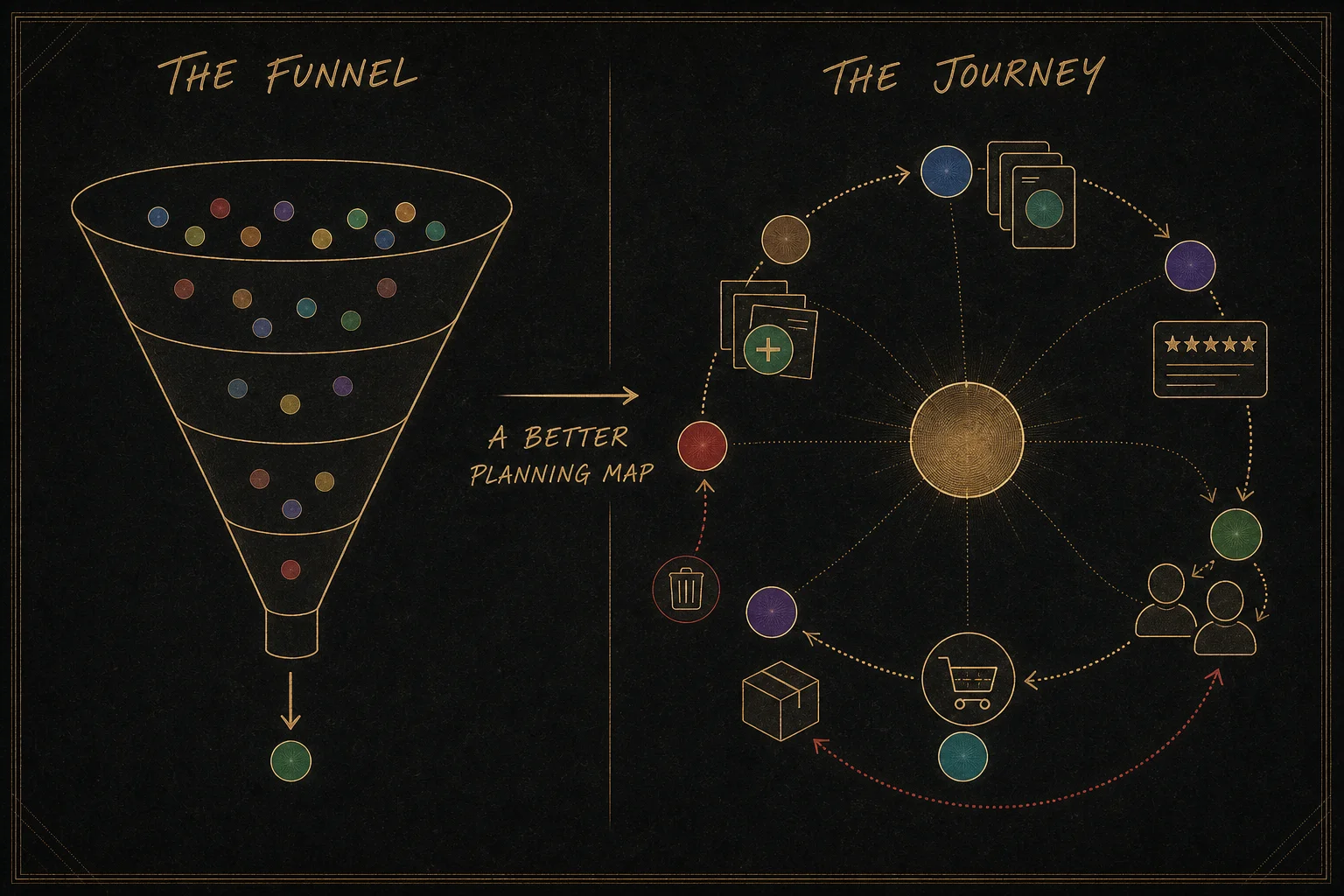
The models answer different questions. A funnel asks how many eligible people progress between defined stages. It is strong for aggregate measurement, conversion operations and locating a loss. A journey asks what people encounter, need and do across a decision. It is strong for experience design, content planning and cross-functional coordination.
Replacing every funnel with a journey can create a beautiful map that no one measures. Replacing every journey with a funnel can create a clean dashboard that no one understands. Use both: the funnel locates the constraint, and the journey helps explain the customer's reality around it.
The funnel counts movement. The journey explains influence.
Limits and common misuses
The Consumer Decision Journey is still a model. It does not predict one person's next action, and its four broad stages can hide meaningful category differences. Business buying may involve committees, procurement and long pauses. Subscription decisions can merge acquisition, onboarding and ongoing value. Habitual purchases may involve little active evaluation.
Journey maps also become weak when they are based only on an internal workshop. Employees can list company touchpoints, but they cannot reliably invent customer motivations. Research with recent decision-makers is essential.
Finally, not every touchpoint deserves equal investment. Prioritize moments where customer need, decision influence, strategic advantage and delivery capability intersect. A complete map is an evidence base, not a command to optimize every box.
Frequently asked questions
What are the four stages of the Consumer Decision Journey?
The four stages are initial consideration, active evaluation, purchase and post-purchase experience. A positive experience can create a loyalty loop that influences the next decision journey.
Who created the Consumer Decision Journey model?
David Court, Dave Elzinga, Susan Mulder and Ole Jorgen Vetvik introduced the model in a 2009 McKinsey Quarterly article based on consumer decision research.
What is active evaluation?
Active evaluation is the phase where buyers research, compare and revise their options. Brands can be added to or removed from the consideration set as new information and experience appear.
What is the loyalty loop?
The loyalty loop describes how a strong post-purchase experience can lead a customer to favour or repeat with a brand in the next decision, sometimes reducing the need for a full fresh evaluation.
Is a customer journey better than a marketing funnel?
Neither is universally better. A funnel is better for aggregate stage measurement. A journey is better for understanding touchpoints, option changes, loops and experience. They work best together.
Sources and further reading
- McKinsey Quarterly: The consumer decision journey ↗Original 2009 model, research basis, four moments and loyalty-loop explanation
- Journal of Marketing: Understanding Customer Experience Throughout the Customer Journey ↗Peer-reviewed synthesis of customer experience across time, touchpoints and channels
- Google: Decoding Decisions, the messy middle of purchase behavior ↗Research on repeated exploration, evaluation and behavioural shortcuts in abundant choice
Explore related concepts
Put this guide to work
Start with the example above, then adapt the assumptions to your audience and evidence. Explore related research guides to compare approaches.
For a project collaboration or a question about applying the framework, contact Rishabh Vats. Include your objective, context and the decision you are working on.