Quick answer
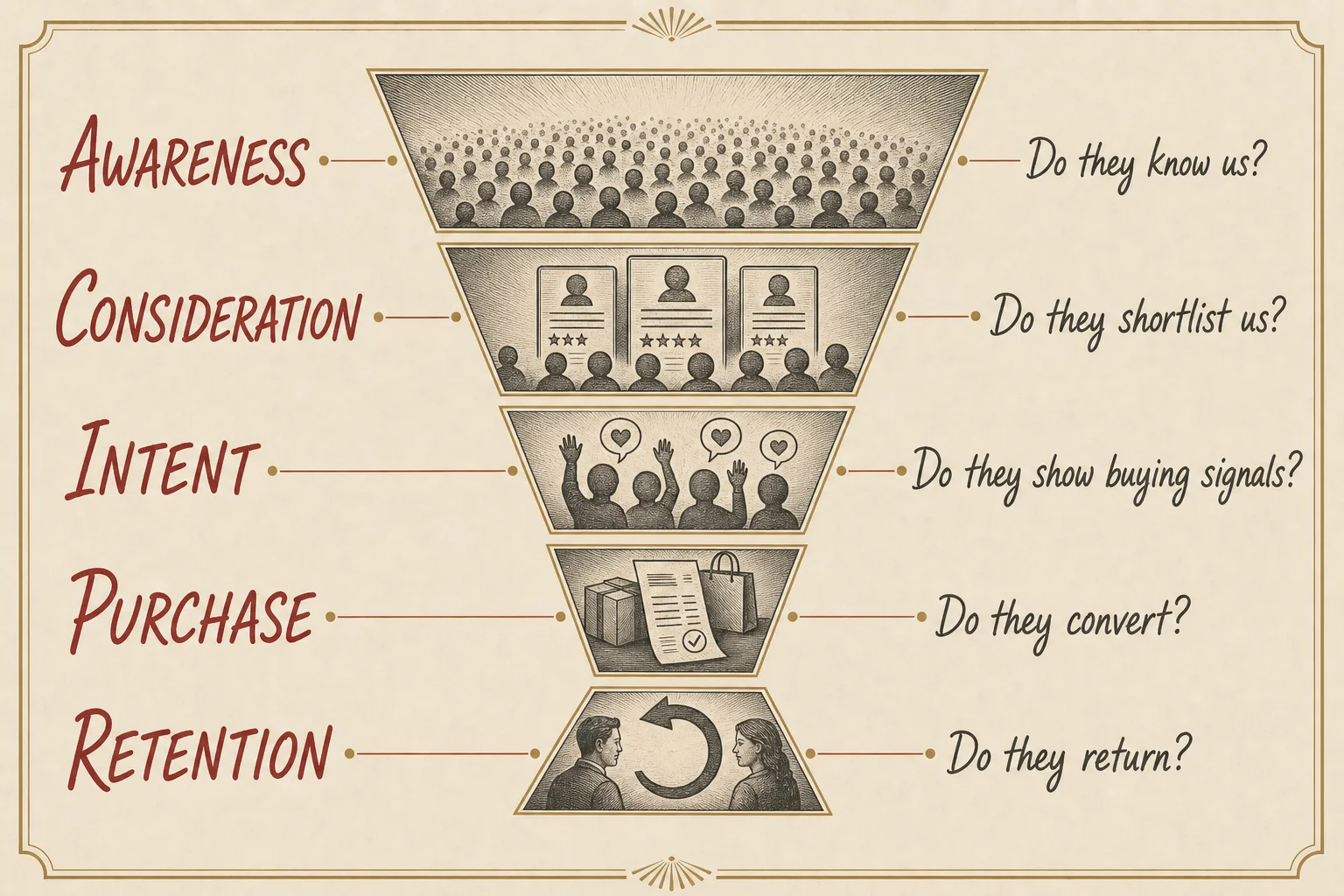
A purchase funnel is a staged view of how a broad market narrows toward purchase and, in stronger versions, retention. A practical model uses Awareness, Consideration, Intent, Purchase and Retention. Measure movement between adjacent stages, find the largest meaningful loss, investigate its cause, and fix that constraint before changing the whole marketing system.
Start here: Separate an observed funnel from the customer’s full journey · Worked example · Original sources
Explore this guide
Separate an observed funnel from the customer’s full journey
A purchase funnel measures defined steps. This numerical example shows how to calculate observed conversion without assuming everyone follows one linear journey.
| Hypothetical website cohort | Conversion from prior step | Interpretation |
|---|---|---|
| 1,000 eligible product-page visitors | Starting base | A measured audience, not the entire market |
| 200 begin checkout | 200 / 1,000 = 20% | Product-page-to-checkout rate |
| 80 complete an order | 80 / 200 = 40% | Checkout completion rate |
| 80 orders from the original cohort | 80 / 1,000 = 8% | Overall observed visitor conversion |
Use consistent identities, time windows and event definitions, and account for repeat visits or cross-device gaps. Diagnose the largest meaningful loss with usability and customer evidence. A person leaving checkout may be comparing delivery, waiting for approval or buying elsewhere; the funnel count cannot tell you which explanation is true.
Original application worksheet for this guide. Illustrative scenarios and numbers are hypothetical. Framework origins and supporting references are listed in the sources.
What is a purchase funnel?
A purchase funnel is a simplified model of movement from a broad potential market toward a smaller group that buys. It turns an otherwise messy set of behaviours into stages that a team can define, count and compare.
The funnel shape makes one basic fact visible: more people can know about an offer than seriously consider it, and more can consider it than purchase it. That is a useful aggregate view. It does not mean every individual moves downward in one uninterrupted line.
The terms purchase funnel, marketing funnel and sales funnel often overlap. A marketing funnel usually starts with market creation and demand. A sales funnel often begins after a lead or opportunity exists. A purchase funnel is best treated as the buyer-state model that connects the two.
How the funnel developed from AIDA
The purchase funnel descends from early hierarchy-of-effects thinking, especially the sequence associated with AIDA: Attention, Interest, Desire and Action. Practitioners turned that communication sequence into a narrowing diagram and later adapted the stages for media planning, brand tracking, lead management, ecommerce and sales operations.
There is no single universal funnel with one authoritative set of labels. Awareness, familiarity, consideration, preference, intent and purchase appear in different combinations. Modern teams often add onboarding, retention and advocacy because the commercial relationship continues after the transaction.
The right stages therefore depend on the decision being managed. A subscription product, a retail purchase and an enterprise contract require different evidence of progress even if the underlying logic is similar.
The five practical purchase funnel stages
A useful stage describes a change in customer state, not merely a channel activity. Seeing an advertisement is an exposure. Awareness is the customer state that exposure may help create. Opening a pricing page is an event. Intent is the interpretation a team may make when that event is combined with context.
Awareness
The relevant market knows the category, problem, offer or brand exists.
- Who should know us?
- What share of that audience can recognize or recall us?
- Which exposures are actually viewable and relevant?
Consideration
The buyer includes the option in a realistic shortlist and begins comparing it.
- Are we in the initial set?
- What information helps comparison?
- Which objections remove us from the shortlist?
Intent
The buyer shows behaviour that suggests a possible near-term purchase or next step.
- What counts as genuine intent here?
- Is the signal strong enough to prioritize?
- What uncertainty is still unresolved?
Purchase
Intent becomes a completed transaction, enrolment, contract or other defined conversion.
- Where does friction stop completion?
- Is the offer and total cost clear?
- Can the buyer complete the action with confidence?
Retention
The customer receives value, stays, returns, renews or recommends the product.
- Did the promise survive contact with the product?
- What creates repeat value?
- What separates passive from active loyalty?
How to measure a funnel without fooling yourself
Start by defining the population and time window. A stage count is meaningless if awareness covers an entire country while purchase covers one campaign audience, or if consideration is measured monthly while intent is measured daily.
Then define an observable rule for every stage. Some states require research, such as awareness and consideration. Others can use behavioural evidence, such as starting checkout or requesting a proposal. Behavioural events are not perfect substitutes for human intent, so document what each event can and cannot prove.
Calculate stage-to-stage movement, not only the final conversion rate. A weak overall rate can hide a healthy early funnel and a broken checkout, or a strong checkout fed by a poor-quality audience. Segment by audience, channel, device, geography, product and customer type only where the sample remains useful.
- Define who is eligible to enter each stage.
- Use the same cohort and a sensible decision window.
- Separate customer states from marketing activities.
- Treat intent signals as evidence, not certainty.
- Check quality after purchase, not only volume before it.
- Record source definitions so the dashboard does not drift over time.
A practical purchase funnel example
The example below shows how the same offer changes meaning at each stage. It also shows why a single message or metric cannot diagnose the entire system.
Imagine an online professional course for first-time managers. The team has strong social reach but weak enrolment and keeps asking for more awareness. The funnel forces a more precise diagnosis.
Relevant professionals see the course and understand that it addresses difficult weekly meetings.
They visit the syllabus, compare the instructor, read learner outcomes and decide whether the course belongs on their shortlist.
They watch the sample lesson, check the schedule, save the page or begin enrolment.
They complete payment and receive immediate confirmation, access details and calendar information.
They finish the first module, use the meeting template, continue the course and later recommend it to another manager.
If many qualified visitors reach the syllabus but few watch the sample lesson, the problem is not automatically awareness. The course may need clearer proof, a better preview, stronger fit information or lower uncertainty at consideration.
Find the largest meaningful leak first
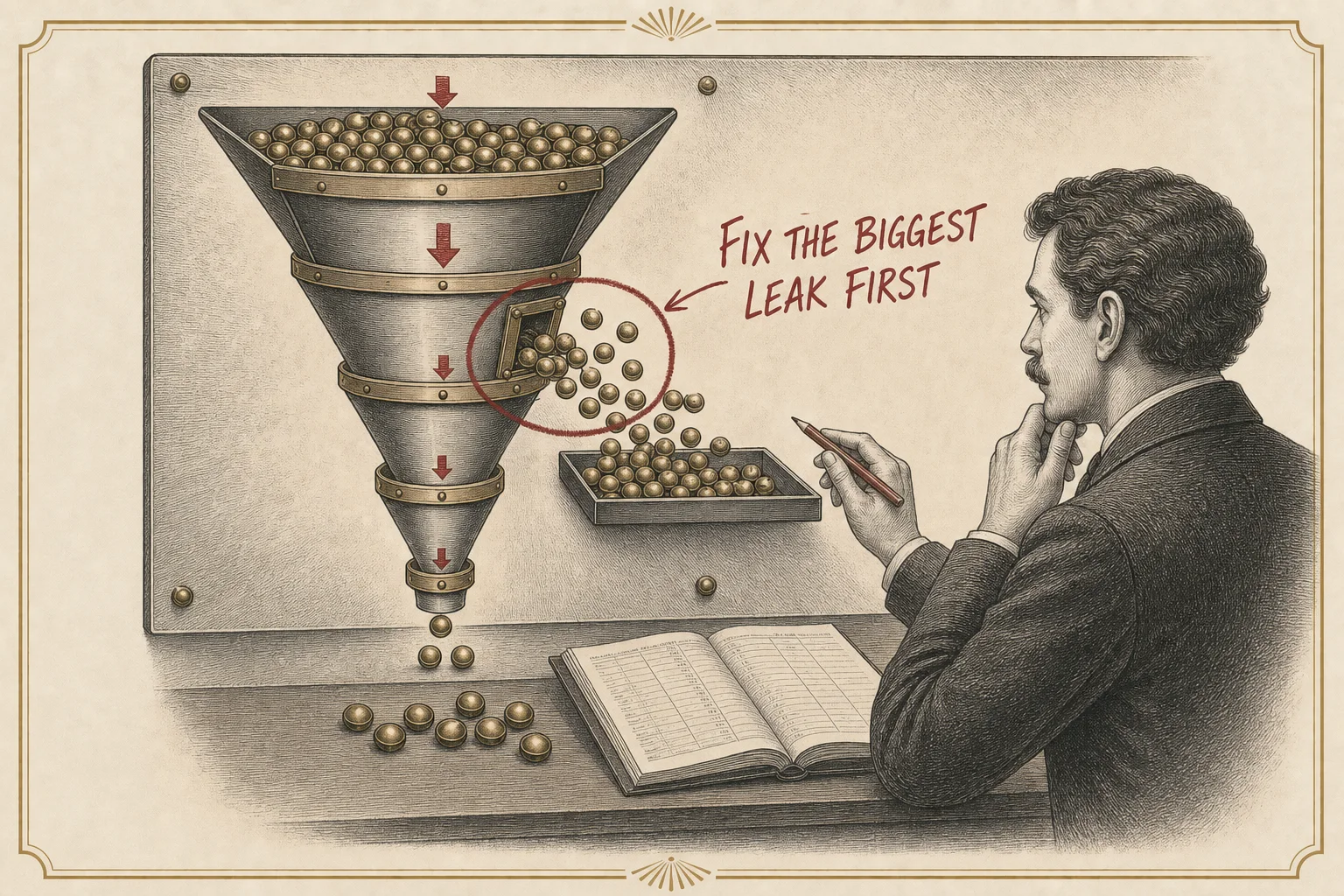
A funnel is a constraint map. Compare adjacent stages, then investigate the largest loss that is both real and commercially important. A large drop is not always a defect. Broad awareness should filter out people who are not a fit, and a qualification step should reject weak leads.
Look for a change against a baseline, a sharp segment difference or a stage where customer evidence shows avoidable friction. Interview customers who progressed and those who stopped. Review search terms, sales calls, support questions, page recordings, survey responses and product analytics. The number locates the problem; qualitative evidence explains it.
Fix one major constraint, then remeasure. Changing audience, offer, pricing, creative, landing page and checkout at the same time may improve results, but it destroys the team's ability to learn what caused the change.
A funnel tells you where to look. It does not tell you why people stopped.
Purchase funnel versus customer journey
Use a funnel when the main question is how many people progress between defined states. Use a journey map when the main question is what people do, feel, need and encounter across touchpoints.
McKinsey's consumer decision journey challenged the idea that buyers only remove brands as they move downward. During active evaluation they can add options, consult reviews, switch channels and return after product experience through a loyalty loop. Google's later messy-middle research similarly describes repeated exploration and evaluation amid abundant information and choice.
The models are complementary. The funnel is useful for aggregate measurement and operational focus. The journey is useful for designing touchpoints, content, service and experience. Strong teams use the funnel to find a constraint and the journey to understand and solve it.
Common purchase funnel mistakes
A funnel becomes misleading when a diagram is mistaken for observed behaviour. Customers enter through search, recommendations, marketplaces, sales conversations and prior experience. They can skip tracked steps, use another device, purchase offline or influence someone else's decision.
Attribution can also distort the picture. The last measurable click may capture a purchase created by earlier brand exposure, product quality, distribution, word of mouth or sales work. Funnel events should support decisions, not claim sole causal credit.
- The stages represent customer states, not a list of channels.
- Every stage has an explicit definition and owner.
- Cohorts and time windows are comparable.
- Research complements behavioural analytics where states are not directly observable.
- Retention and customer experience are visible after purchase.
- The team investigates causes before prescribing tactics.
- A journey map is used when touchpoint complexity matters more than stage volume.
Frequently asked questions
What are the stages of a purchase funnel?
A practical purchase funnel uses Awareness, Consideration, Intent, Purchase and Retention. Teams may rename or split stages to match the actual decision, but each stage should represent a distinct customer state.
Is a purchase funnel the same as a sales funnel?
They overlap, but a purchase funnel describes the buyer's movement across the whole decision. A sales funnel usually tracks known leads or opportunities through a selling process managed by a sales team.
How do you calculate funnel conversion?
Divide the number of people who reach a later stage by the eligible number in the preceding stage for the same cohort and time window. Also inspect final conversion, quality and retention rather than optimizing one ratio in isolation.
Why do customers drop out of a funnel?
Some loss is healthy filtering. Avoidable loss can come from weak fit, unclear value, missing proof, high effort, price surprise, poor timing, technical friction or a stronger alternative. Analytics locates the drop; customer evidence explains it.
Is the marketing funnel outdated?
The funnel remains useful for aggregate measurement and constraint diagnosis. It is incomplete as a literal map of individual behaviour, so pair it with a customer journey when loops, channels, social influence and post-purchase experience matter.
Sources and further reading
- EBSCO Research Starter: AIDA model ↗Historical relationship between AIDA, hierarchy models and funnel thinking
- Cambridge University Press: The Purchase Funnel and Litigation ↗Academic description of the funnel as distinct decision hurdles from awareness through post-purchase
- McKinsey: The consumer decision journey ↗Evidence for non-linear evaluation, brand additions and the loyalty loop
- Google: Decoding Decisions, the messy middle of purchase behavior ↗Research on repeated exploration and evaluation amid abundant information and choice
Explore related concepts
Discuss an application
Use the worksheet and example to define your decision first. For a project collaboration, contact Rishabh Vats with your objective, context and the evidence you already have.