
Quick answer
AIDA is a four-part model for persuasive communication: win Attention, hold Interest, create Desire, then make the next Action clear. Use it to structure an ad, email, landing page, sales message, or presentation. Do not treat it as proof that real customers always buy in a neat linear order.
Start here: A practical AIDA example · Original sources
Explore this guide
What does AIDA mean?
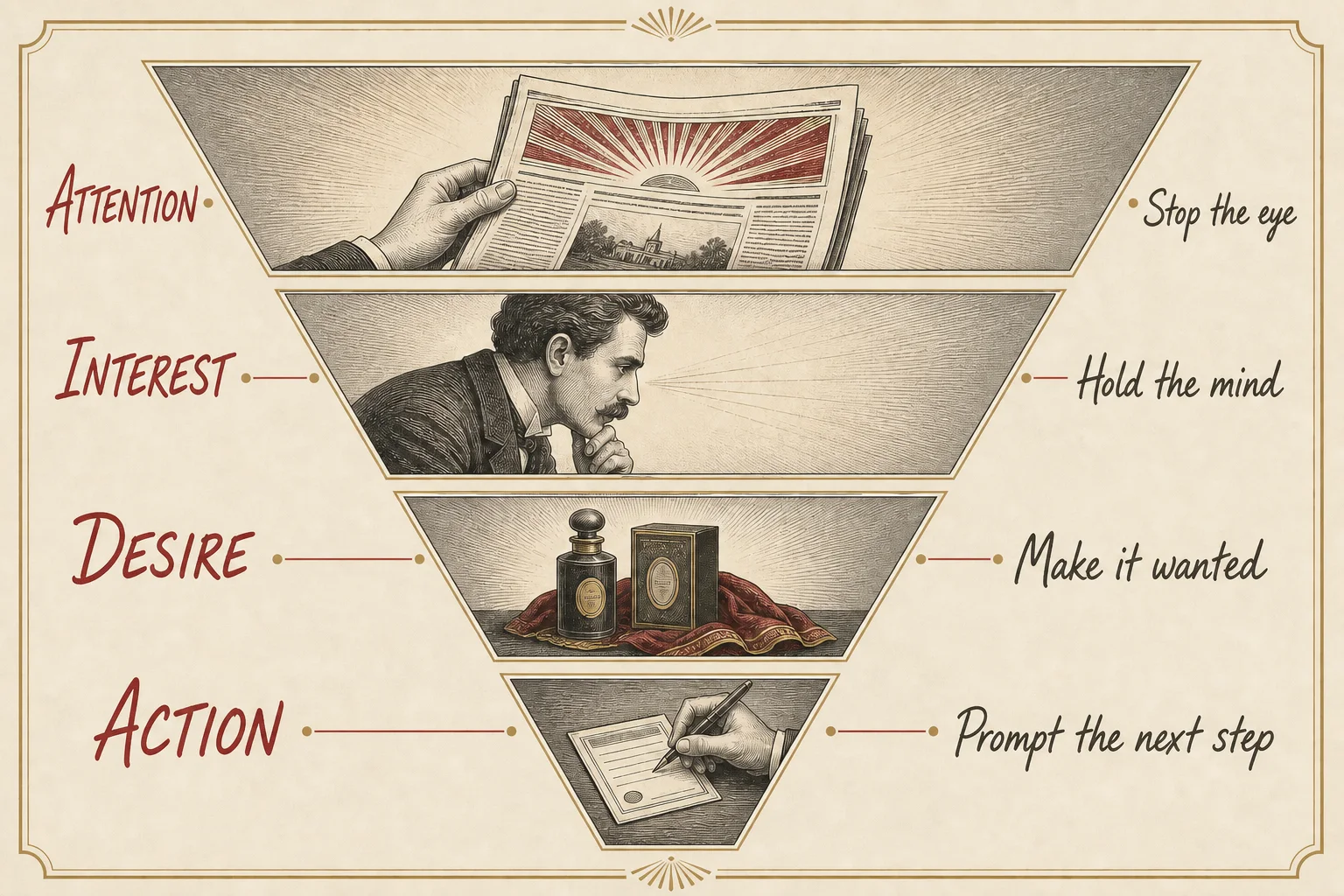
AIDA stands for Attention, Interest, Desire and Action. It belongs to a family of hierarchy-of-effects models, frameworks that describe persuasion as movement from cognition to feeling and then behaviour.
The model is often drawn as a funnel because many people may notice a message, fewer will stay interested, fewer still will want the offer, and only some will act. That picture is useful for planning communication, but it is a simplification, not a law of buyer behaviour.
Where did the AIDA model come from?
The model is commonly traced to American advertising and sales pioneer E. St. Elmo Lewis. Around 1898, Lewis began using phrases built around attracting attention, maintaining interest and creating desire. The instruction to get action appeared later, and subsequent writers helped standardise the familiar four-letter form.
That distinction matters. AIDA did not arrive as one perfect diagram on a single day. It developed as practitioners tried to turn persuasion into a sequence that salespeople and advertisers could learn, apply and improve.
The four AIDA stages
Each stage has a different job. A common mistake is asking one headline, visual, or paragraph to perform all four jobs at once. Clear communication gives each job enough space and makes the transitions feel natural.
Attention
Earn the first moment of notice from the right audience.
- What interrupts the pattern?
- Is the hook relevant, not merely loud?
- Can the audience understand the subject immediately?
Interest
Give people a reason to keep reading, watching, or listening.
- What useful tension or problem is being opened?
- Why should this audience care now?
- Is the explanation specific enough to reward attention?
Desire
Turn understanding into preference by connecting the offer to a wanted outcome.
- What changes for the customer?
- What proof makes the promise believable?
- Why this option instead of the alternatives?
Action
Make one appropriate next step obvious and easy.
- What exactly should the person do?
- Is the ask proportionate to their level of trust?
- What friction can be removed?
A practical AIDA example
The model becomes easier to understand when one message is separated into four deliberate moves.
Imagine a landing page for a practical online course that helps first-time managers run clearer weekly meetings. The audience already feels meeting fatigue but may not know a course can solve it.
Your team does not need another meeting. It needs one decision everyone can repeat.
A short course shows new managers how to set the decision, structure the agenda, and close with named owners.
Participants leave with a reusable agenda, decision log, and follow-up template, plus worked examples for common meeting problems.
View the first lesson, then decide whether the full course fits.
Notice that the action is not automatically 'buy now'. For a lower-trust or higher-consideration offer, the right action may be to view a lesson, compare options, request a demo, or save the guide.
The better way to write with AIDA: work backwards
Start with Action. Decide the one next step the message should earn. Then define the Desire that would make that action sensible, the Interest needed to understand the value, and the Attention device that can open the conversation honestly.
Working backwards stops the hook from becoming disconnected clickbait. It also exposes weak offers early. If the desired action feels too large, or the desired outcome has little proof, no amount of attention will repair the structure.
- Action: define the smallest meaningful next step.
- Desire: state the outcome and the reason to prefer this offer.
- Interest: choose the problem, insight, mechanism, or proof that deserves more attention.
- Attention: create a relevant opening that signals the value to the right person.

Where AIDA is most useful
AIDA works best as a communication checklist for a bounded asset. It is especially helpful when the reader can move from a clear opening to a clear next step in one sitting.
- Landing pages and product pages
- Short sales emails and outreach messages
- Advertisement scripts and storyboards
- Social posts with a defined response
- Pitch openings and presentation narratives
- Creative reviews where a message feels incomplete
Where the AIDA model fails
Real buying journeys are rarely linear. People search, compare, leave, return, ask others, encounter a brand through several channels, and continue judging the experience after purchase. AIDA does not naturally represent those loops, social influences, retention, or product experience.
A major review of advertising research by Demetrios Vakratsas and Tim Ambler found little support for one universal temporal hierarchy of advertising effects. Context, category, competition, prior experience and the objective of the advertising all matter.
Use AIDA to structure a message, diagnose a weak transition, or align creative roles. Do not use it as a complete customer-journey model, an attribution model, or a guarantee that attention will become purchase.
AIDA is a useful grammar for persuasion. It is not a complete theory of how every person buys.
AIDA checklist for reviewing a message
Before publishing, read the asset once for each stage. Ignore the other stages during that pass.
- Attention: the opening is immediately understandable to the intended audience.
- Interest: the next section rewards attention with useful specificity.
- Desire: the desired outcome, differentiation and proof are visible.
- Action: one next step is clear, proportionate and low-friction.
- Continuity: every stage supports the same promise and audience.
- Integrity: the hook and proof do not exaggerate what the offer can deliver.
Frequently asked questions
What does AIDA stand for in marketing?
AIDA stands for Attention, Interest, Desire and Action. It describes four jobs a persuasive message can perform, from earning notice to prompting an appropriate next step.
Who created the AIDA model?
The model is commonly traced to E. St. Elmo Lewis, who began articulating attention, interest and desire around 1898. Action was added later, and later writers helped standardise the modern AIDA form.
Is AIDA the same as a marketing funnel?
AIDA is often shown as a funnel and influenced later funnel thinking. It is best understood as a communication hierarchy. A full marketing funnel usually includes channels, conversion stages, measurement, retention and repeat behaviour that AIDA does not cover.
Is the AIDA model still relevant?
Yes, when used as a simple structure for an ad, email, landing page, pitch or creative review. It becomes misleading when treated as a complete, linear map of modern customer behaviour.
What is the best way to apply AIDA?
Write backwards. Define the action first, then the desire that would justify it, the interest needed to explain the value, and finally the attention device that opens the message without becoming clickbait.
Sources and further reading
- EBSCO Research Starter: AIDA model ↗Overview, historical development and the four-stage model
- Vakratsas and Ambler: How Advertising Works ↗Academic review of advertising-effects models and the limits of universal hierarchies
- EBSCO Research Starter: Customer journey ↗AIDA in relation to later journey and hierarchy models