Quick answer
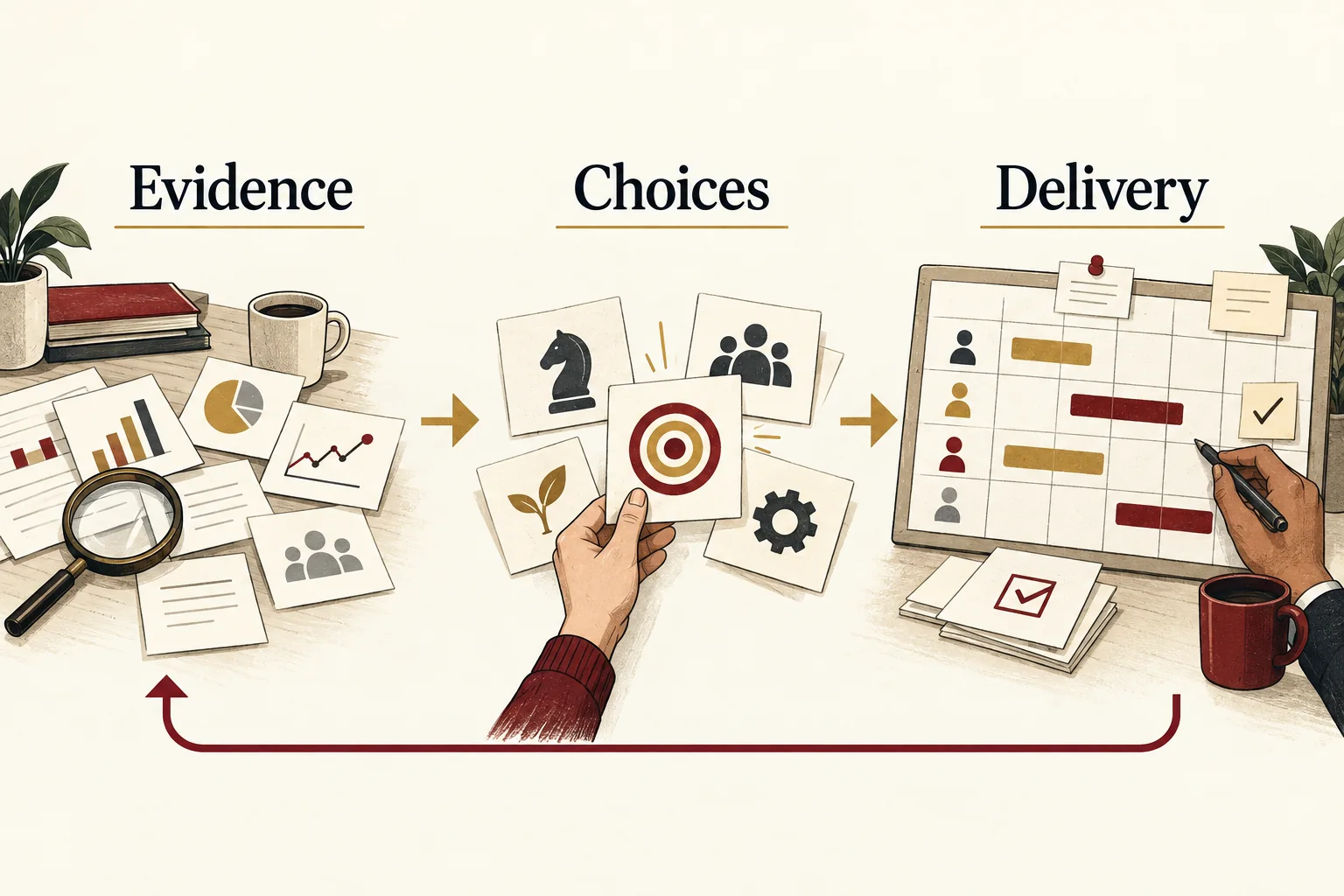
SOSTAC® is PR Smith's planning methodology: Situation analysis, Objectives, Strategy, Tactics, Actions and Control. It connects evidence about the current position with desired outcomes, strategic choices, detailed programs, execution responsibilities and measurement. The six headings organize a plan; they do not make the strategic decisions for you. Control feeds learning back into the next situation analysis, so the plan can change when evidence changes.
Start here: Worked example: a repairable-backpack pilot · Original sources
Explore this guide
What SOSTAC® helps a team decide
SOSTAC® is a planning structure with a methodology behind it. Its value is the connection between sections: objectives should answer the situation, strategy should explain how those objectives might be achieved, and delivery should express that strategy. A folder containing six unrelated documents satisfies the acronym but misses this connection.
The method can organize a business, marketing, digital or campaign plan. Scope still matters. A campaign team may control creative and distribution but not product availability or service quality. Record those dependencies rather than assuming the plan can command them. A short campaign plan and a company plan can use the same headings with different levels of detail.
This guide credits the methodology to PR Smith. The Chronology contributes its curation, connections, organization and presentation, including the explicitly hypothetical application below. The explanation is an introduction to applying the model, not a claim to replace Smith's books or formal training.
Origin, attribution and the book context
Dave Chaffey's author-site explanation places PR Smith's creation of SOSTAC® in the 1990s. It also describes its later application to digital marketing in their coauthored work. That supports a decade-level chronology; it does not establish a single exact invention date. This guide therefore uses the 1990s rather than presenting an unsupported year as settled history.
Smith's own site presents SOSTAC® as his planning methodology and directs readers to his SOSTAC® Guide to Your Perfect Digital Marketing Plan. His bibliography records a SOSTAC® guide in 2011. Digital Marketing Excellence, coauthored with Dave Chaffey, provides a wider textbook setting for integrated digital planning. Later editions and new diagrams should not be confused with the original creation of the model.
The six stages and their distinct jobs
The six headings have different responsibilities. Keep Situation analysis focused on evidence, Objectives on outcomes and Strategy on choices. Tactics specifies the chosen marketing activity. Actions establishes the organization needed to execute it. Control defines how evidence will trigger decisions. Use the questions below to test whether each heading is doing its own job.
The stage cards are practical prompts developed for this guide. They interpret the methodology for a working team rather than reproduce an official template. A useful test is to trace one important activity backward to its strategic reason and forward to an accountable owner and decision measure. If the chain breaks, repair that connection before adding more detail.
Situation analysis
Establish the current customer, competitive and organizational position before choosing a response.
- Which customer problem is supported by evidence?
- What is working, and what constrains us?
Objectives
Specify the outcomes the plan should achieve within a defined period.
- What needs to change?
- Which baseline and deadline make progress assessable?
Strategy
Make coherent choices about the route to those outcomes and the trade-offs it requires.
- Which market will we prioritize?
- Why should this approach work better than the alternatives?
Tactics
Design the detailed mix of offers, channels and activities that expresses the chosen strategy.
- What will customers encounter?
- How do the selected activities support one another?
Actions
Make delivery feasible through ownership, skills, internal communication and managed dependencies.
- Who does what, when and how?
- What must be ready before the work launches?
Control
Use evidence and review rules to decide whether the plan is progressing and what should change.
- How will we recognize a material problem?
- Who can adapt or stop the program?

Connect diagnosis to measurable objectives
Begin with a bounded situation question. For a new service, it might be whether customers understand the promise and whether operations can deliver it. Gather customer evidence, performance data, competitor alternatives and relevant external constraints. Separate a finding from an assumption: a few interviews can identify a problem but cannot establish its population prevalence.
Convert the important findings into a small number of objectives. Each needs a defined outcome, baseline, target, period and owner. If no baseline exists, the first objective may be to establish reliable measurement or validate a critical assumption. Avoid manufacturing precision merely because the planning template contains a target field.
PR Smith's 5Ss provide one way to broaden objective selection beyond sales alone. Customer service, dialogue, efficiency and brand experience may matter alongside commercial results. They remain categories for thinking; the team must choose measures relevant to its actual problem and avoid treating every category as an equal spending requirement.
Keep strategy, tactics and actions separate
A strategy makes choices under constraints. For example, prioritizing commuters within a dependable repair service area is a strategic boundary. A product demonstration, retailer session and search campaign are tactics serving that boundary. Booking the session, checking stock and assigning a presenter are actions. All three matter, but they solve different problems.
Smith's current strategy guidance uses TOPPP SEED to test the coherence of choices, including target markets, positioning, partnerships and customer experience. Use it to expose a contradiction, such as promising immediate support while choosing a delivery model that cannot provide it. Filling every checklist field with attractive words is not evidence of a viable strategy.
Actions deserves its own attention because execution depends on people. A channel plan can fail when the retailer misunderstands the promise or the service team lacks parts. Include training, communication, capacity and decision rights alongside the schedule. Readiness should determine the launch date where a dependency could materially harm the experience.
Worked example: a repairable-backpack pilot
The Mendway example keeps one strategic assumption visible: selected commuters might value a dependable repair promise enough to choose a different backpack. The plan coordinates the evidence, offer and service operation needed to test that assumption. It does not treat more promotion as the answer to every uncertainty.
Read the six decisions as a connected argument. The limited service area determines targeting, targeting influences the channel choice, and the channel promise determines the operational check. A different situation, such as proven national repair coverage, could justify a different plan without changing the methodology.
Mendway is a fictional company testing repairable commuter backpacks in one city. It has a working prototype and limited repair capacity. The following 90-day plan is illustrative, not a report of observed business results.
Interviews suggest broken fasteners interrupt commuting, but willingness to pay for repairability remains uncertain. Operations can support a small local pilot, not national demand.
Set an illustrative goal of 100 completed pilot orders in 90 days, with at least 90% of pilot repairs completed within the promised service window. Replace both targets after validating capacity and demand.
Prioritize frequent laptop commuters in the service area. Compete on dependable repair access and clear proof. Exclude outdoor expedition users and nationwide promotion during the pilot.
Use a repair demonstration page, a commuter retailer trial, a small acquisition experiment and post-purchase care guidance. Each touchpoint explains the same repair promise.
Operations stocks parts; service trains the repair team; marketing verifies the demonstration and briefs the retailer. Promotion begins only after the repair workflow passes a rehearsal.
Review orders and service exceptions weekly. Review promise comprehension and unit economics monthly. Pause expansion if service fails its agreed threshold, even when orders rise.
All company details and targets are hypothetical teaching choices. The example illustrates planning logic and does not establish benchmarks or guarantee outcomes.

Use control to learn and change the plan
Control needs a decision design as well as a dashboard. Specify the measure, source, owner, review frequency and action available when a threshold is crossed. A daily service exception may require immediate intervention, while awareness or repeat buying may need a longer observation period. Match the cadence to the behavior rather than collecting every metric daily.
Distinguish monitoring from causal evaluation. Orders rising after a campaign does not alone show the campaign caused the increase. Seasonality, distribution and existing demand may contribute. Where the budget decision depends on incremental impact, use a credible experiment or comparison and state its limitations. Qualitative feedback can explain mechanisms but cannot by itself quantify an uplift.
Feed what you learn back into Situation analysis. If customers misunderstand repair eligibility, the next decision may concern the offer and explanation. If comprehension is high but demand is weak, revisit the target or proposition. Revising the plan in response to evidence is part of disciplined planning, not an admission that the method failed.
PR Smith's books and further study
For the creator's fuller treatment, start with Smith, PR (2025), SOSTAC® Guide to Your Perfect Digital Marketing Plan, AI Edition. Smith's official January 2025 article introduces that edition. It is an existing book about planning in an AI context and should not be confused with the separately announced AI Assisted Planning tool below.
For the wider communications setting, see Zook, Z. and Smith, PR (2024), Marketing Communications, eighth edition, Kogan Page. The publisher's current subtitle is Integrating Online and Offline, Customer Engagement and Digital Technologies. The edition was published on 3 March 2024. It complements the focused SOSTAC® guide with a broader communications text.
For integrated digital marketing, see Chaffey, D. and Smith, PR (2023), Digital Marketing Excellence: Planning, Optimizing and Integrating Online Marketing, sixth edition, Routledge. The 2023 reference is the edition's copyright year used in Smith's supplied bibliography. Links to the official creator or publisher records, and to Smith's other books, appear in Sources and further reading.
Smith's wider bibliography also includes SOSTAC® Guide to Writing the Perfect Plan (2011); Great Answers to Tough Marketing Questions, second edition (2003); Strategic Marketing Communications, revised edition, coauthored with C. Berry and A. Pulford (1999); and Great Moments of Sportsmanship (2009). His official book list and biography, linked below, provide the routes to these earlier works. These historical titles complement the current planning and communications editions rather than replacing them.
Eight official resource routes from PR Smith
Smith's resource collection accompanies the model with several ways to learn. The list below preserves its eight categories and directs readers to the relevant official sources. The supplied infographic appears earlier in this guide with its requested permission credit. The external resources remain the work of their respective creators and publishers.
The free reading and video routes provide a starting point; the course and masterclass routes offer structured study. Check the provider for current availability, enrollment conditions and pricing. The weekly AI, Innovation and Ethics conversation is listed by Smith as a Friday session at 1:00pm UK time; consult his current event listing before joining.
- 1. SOSTAC® infographic: the creator-supplied diagram is reproduced in the six-stages section, with permission and retained attribution.
- 2. SOSTAC® Plans Explained: the official sostac.org site includes a short introductory video.
- 3. Weekly AI, Innovation and Ethics in Marketing chat: see PR Smith's LinkedIn events and official site for the current session.
- 4. Marketing Communications sample chapter: the eighth-edition Kogan Page record provides the publisher's sample-chapter route.
- 5. SOSTAC® memes and quotation graphics: PR Smith's Gallery is the official collection linked below.
- 6. Courses and masterclasses: the creator's SOSTAC® page links introductory study and workshops; sostac.org provides Associate and Certified Planner information.
- 7. Books: the 2025 SOSTAC® AI Edition, 2024 Marketing Communications eighth edition and 2023 Digital Marketing Excellence sixth edition are identified above.
- 8. Articles and current commentary: PR Smith's official blog and LinkedIn profile provide the reading routes from his resource collection. The six selected blog articles from that collection are also linked below as further reading.
SOSTAC® AI Assisted Planning tool: announced October 2026 pilot
Status as of 8 September 2026: PR Smith has announced an October 2026 pilot for his SOSTAC® AI Assisted Planning tool in correspondence supplied for this guide. This is an upcoming, creator-announced pilot, not a statement that the tool is publicly launched or available to every reader.
In his 8 September 2026 update, PR Smith said further tool information and an official registration-of-interest link would follow. That link is not yet available for this guide. The Chronology has not tested the tool. Follow his official channels for confirmed access details; the planning methodology, the 2025 AI Edition book and the forthcoming tool remain distinct resources.
Creator-announced timing: October 2026 pilot. Update dated 8 September 2026; further information and the official registration-of-interest link are pending.
Limitations and common mistakes
SOSTAC® does not validate the market, produce a competitive advantage or guarantee revenue. It makes the assumptions and delivery logic easier to inspect. Weak evidence remains weak even when presented under the right headings. An organization can execute a coherent plan efficiently and still discover that the customer does not value its proposition.
Common mistakes include writing tactics first and inventing a strategy afterward, confusing channel metrics with business objectives, and treating Control as an end-of-project report. Another is filling Situation analysis with exhaustive background that never changes a choice. Keep supporting detail available, but make the implications easy for decision makers to find.
Use the methodology proportionately. A small pilot may need a concise core document with linked working notes. A complex launch needs deeper financial, operational and research support. The test is whether the people involved can understand the decisions, execute their responsibilities and recognize when the plan should change.
- Define the planning scope, period and decision owner
- Separate verified situation findings from assumptions
- Give objectives a baseline, target, deadline and owner
- State the strategic target, promise and exclusions
- Connect every major tactic to a strategic reason
- Assign delivery owners, resources and readiness checks
- Define measurement methods and decision thresholds
- Record what changed when Control informs the next plan
A SOSTAC® plan is useful when its six sections form one testable argument about how a chosen market outcome could be achieved.
Frequently asked questions
What does SOSTAC® stand for?
Situation analysis, Objectives, Strategy, Tactics, Actions and Control. PR Smith's methodology connects the current position to desired outcomes, choices, detailed programs, execution and review.
Who created SOSTAC®?
PR Smith created SOSTAC®. Dave Chaffey's account places its creation in the 1990s. This guide does not claim a more precise debut date than the sources establish.
What is the difference between SOSTAC® strategy and tactics?
Strategy makes the choices about the route to the objective, including whom to serve and how to compete. Tactics specifies the marketing mix and programs that carry those choices into the market. Actions assigns the people and work needed to deliver them.
Does a SOSTAC® plan have to be long?
No fixed length is required for the explanation in this guide. Use enough detail to support choices, ownership, resources and review. The amount depends on the planning scope and the consequences of a weak assumption.
Is the SOSTAC® AI Assisted Planning tool available?
As of 8 September 2026, PR Smith has announced an October 2026 pilot and said further information and an official registration-of-interest link will follow. The Chronology has not tested the tool; consult his official channels for confirmed access details.
Sources and further reading
- PR Smith's SOSTAC® official site: video and Certified Planner ↗Official introductory video and planning certification information; consult the provider for current course and enrollment details.
- PR Smith: SOSTAC® Planning ↗Creator's current explanation of the six stages, 5Ss objective categories and TOPPP SEED strategy checklist; checked 8 September 2026
- Dave Chaffey: SOSTAC® Marketing Plan Model ↗Coauthor's explanation and attribution of SOSTAC®'s creation to PR Smith in the 1990s
- PR Smith: Biography and bibliography ↗Author's bibliography, including the 2011 SOSTAC® guide and coauthored marketing textbooks
- Chaffey, D. and Smith, PR (2023): Digital Marketing Excellence, sixth edition ↗Routledge publisher record: Planning, Optimizing and Integrating Online Marketing; 2023 is the edition's copyright year
- Smith, PR (2025): SOSTAC® Guide to Your Perfect Digital Marketing Plan, AI Edition ↗Creator's introduction to the 2025 AI Edition and route to the book; distinct from the upcoming AI Assisted Planning tool
- Zook, Z. and Smith, PR (2024): Marketing Communications, eighth edition ↗Kogan Page publisher record and sample-chapter route; subtitle: Integrating Online and Offline, Customer Engagement and Digital Technologies
- PR Smith: Books ↗Creator's wider bibliography and current book information
- PR Smith: Gallery ↗Official collection of SOSTAC® and other quotation graphics referenced in Smith's resource document
- PR Smith: Blog ↗Official articles and updates; a route for following forthcoming developments, not independent evidence that the announced AI pilot has launched
- Follow PR Smith on LinkedIn ↗PR Smith's professional profile and Events listings, linked from his official sites.
- PR Smith: Will ChatGPT + ChatBots + Avatars Make Us Immortal? ↗Selected further reading from Smith's supplied resource collection; AI and social implications, published March 2023
- PR Smith: Meet Ai-Da, a Performing AI-Driven Artbot ↗Selected further reading from Smith's resource collection; AI and creativity, published October 2022
- PR Smith: The Dark Arts of Marketing ↗Selected further reading from Smith's resource collection; commentary on data and influence, published March 2018
- PR Smith: Great Covid Idea, Walls of Gold ↗Selected further reading from Smith's resource collection; an innovation example, published November 2022
- PR Smith: Industry 5.0, What's It All About? ↗Selected further reading from Smith's resource collection; technology and industry commentary, published September 2022
- PR Smith: AI and Data, Crisis Coming? ↗Selected further reading from Smith's resource collection; data and AI commentary, published August 2021
- PR Smith's SOSTAC® introductory video (3 minutes) ↗The short planning video embedded on the official SOSTAC® website.
- PR Smith's SOSTAC® Certified Planner course ↗Official course information. Current requirements, duration, assessment and availability are set by the provider.
- PR Smith's introductory SOSTAC® course on Udemy ↗Marketing Plan - Write The Perfect Plan: SOSTAC® framework, presented by PR Smith; introductory study, separate from the Certified Planner course.
- PR Smith's SOSTAC® Plans Club: AI, Innovation and Ethics ↗Creator's current Q3 2026 discussion summaries and recordings. For upcoming sessions, see Events on PR Smith's LinkedIn profile.
- PR Smith’s SOSTAC® LinkedIn group ↗SOSTAC® community link supplied in PR Smith’s resource guidance; platform and group access conditions apply.
- PR Smith's SOSTAC® Instagram ↗Official social-resource link supplied by PR Smith in his attribution guidance: @sostac_planning.