
Quick answer
A creative brief is the working contract between strategy and creative development. It defines the objective, audience, insight, single-minded proposition, proof, desired response and guardrails. A good brief reduces ambiguity while leaving room for many creative executions. It should make the strategic choice clear, not prescribe the final idea.
Start here: A creative brief review before production · Worked example · Original sources
Explore this guide
A creative brief review before production
Review the creative brief before production starts. These checks expose missing decisions that polished layouts and extra copy cannot repair.
| Check | Question for the reviewer | Revision trigger |
|---|---|---|
| One objective | What should the audience do differently? | Multiple unrelated outcomes compete |
| One proposition | What is the most important believable promise? | The brief lists features without choosing |
| Support | What evidence can the creative actually show? | A claim exceeds available proof |
| Delivery | Where will it run and what must fit? | Format, owner or deadline is unresolved |
Ask a person outside the project to summarize the intended audience, promise and action from the brief. If their answer differs from the team’s, resolve the brief before judging concepts. This is a comprehension check, not evidence that the campaign will sell.
Original application worksheet for this guide. Illustrative scenarios and numbers are hypothetical. Framework origins and supporting references are listed in the sources.
What is a creative brief?
A creative brief is a concise decision document that translates marketing strategy into a problem a creative team can solve. It aligns the client, strategist, account team, copywriter, designer, art director, producer and channel specialists around one objective and one central direction.
The word brief matters. The document should contain the information that changes the quality or direction of the work, not every fact discovered during research. Background material can sit in an appendix or source folder. The brief itself must remain usable during ideation, review and production.
A creative brief is also different from a project plan. A project plan manages scope, owners, timing and deliverables. A brief explains why the communication exists, who must respond, what strategic idea matters and what evidence supports it. Strong projects need both.
What a brief should do
The brief should direct and inspire. Direction comes from real choices: one audience priority, one problem, one proposition and one desired response. Inspiration comes from an insight or tension that gives creative people something worth exploring.
The IPA's guidance on client briefing emphasizes giving an agency the right information so it can return with the best possible solution. BetterBriefs and IPA research also highlights a persistent alignment gap between marketers who believe their briefs are clear and agencies that experience them as unclear or strategically weak.
The solution is not a longer template. It is better thinking before the template is filled. If the strategy is unresolved, the creative process becomes an expensive place to debate targeting, positioning and objectives after ideas have already appeared.
The seven sections of a useful creative brief
Templates vary, but the strongest fields perform seven essential jobs. Each section should sharpen the same strategic choice. If two sections point toward different audiences or promises, the brief is not ready.
Objective
Define the change the communication must help create and how success will be judged.
- What business or behaviour problem matters?
- What can communication credibly influence?
- What would progress look like?
Audience
Describe the people whose behaviour or perception must change in decision-relevant terms.
- Who exactly must respond?
- What are they doing now?
- What tension matters in this situation?
Insight
Name a useful human or cultural truth that creates leverage for the objective.
- What is true but not obvious?
- Why does current behaviour make sense?
- Can the creative team recognize and use the tension?
Proposition
State the one thing the communication should leave in the audience's mind.
- Is it one clear promise or idea?
- Is it relevant and differentiating?
- Can it inspire several executions?
Proof
Supply the reasons the audience can believe the proposition.
- What makes the promise credible?
- Is the support demonstrable?
- Which proof matters most to this audience?
Response
Define what people should think, feel or do after encountering the work.
- What immediate response is realistic?
- Is action required now?
- Does the response connect to the objective?
Guardrails
State genuine constraints without solving the creative problem in advance.
- What is mandatory?
- What is prohibited for a real reason?
- Which deliverables, timing and legal limits matter?
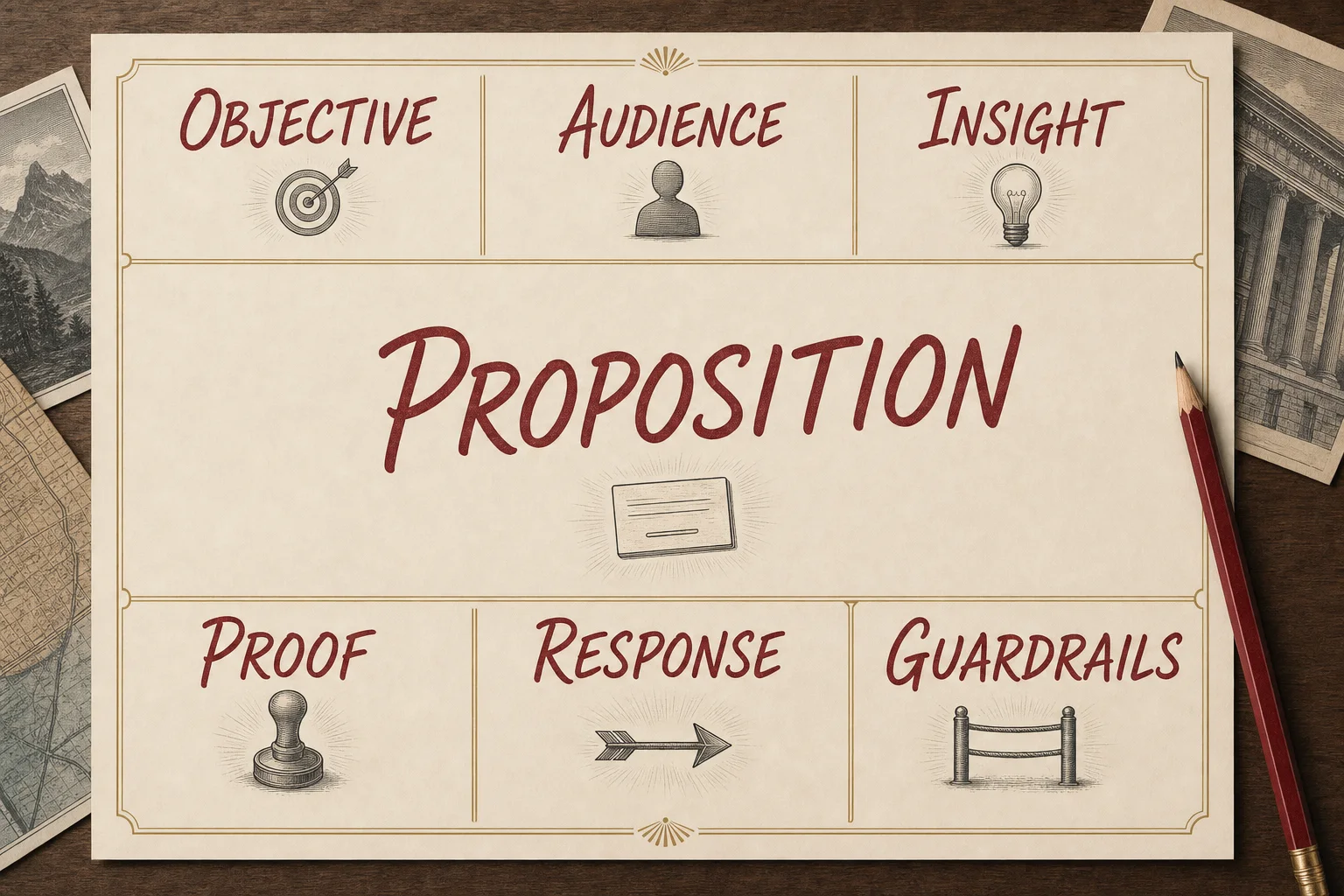
Copy this creative brief template
Copy these seven fields into your document and replace the bracketed prompts. Keep each answer focused on the same audience, objective and proposition. Use the worked example below to check the level of detail.
Creative brief — blank template
[The specific change, priority audience, timing and measure of success]
[Who needs to respond, their current behaviour and the decision that matters]
[The evidence behind a useful tension, barrier or motivation]
[One clear idea or promise the audience should take away]
[The product truth, demonstration or evidence supporting the proposition]
[What the audience should think, feel or do next]
[Deliverables, timing, mandatories and genuine constraints]
Final check: do all seven answers support one clear strategic choice? Keep supporting research in an appendix.
How to write the single-minded proposition
The proposition is the one idea the communication should leave behind, not necessarily the line that appears in the advertisement. It should be an internal strategic sentence that creative teams can transform into stories, demonstrations, images, experiences and language.
A proposition becomes weak when it joins several promises with and, lists product features, uses category clichés or describes what the company wants to say rather than what the audience can value. It becomes over-prescriptive when it already sounds like a finished headline and leaves no room for creative discovery.
Test it by asking different creative people for three possible routes. If every route is identical, the proposition may be an execution. If the routes have nothing in common, it may be too vague. A strong proposition creates a shared strategic center and diverse creative possibilities.
- Write one complete sentence without joined benefits.
- Connect the promise to the audience's situation or tension.
- Make the reason to choose visible, not merely positive.
- Support it with proof the product or brand can deliver.
- Remove campaign language and test whether the underlying idea remains.
A practical creative brief example
The commuter-backpack example below moves from a real product truth to one focused creative opportunity. Each section earns its place by changing the direction of the work.
Imagine a commuter-backpack brand launching a repairable bag for young professionals who replace inexpensive bags after zips or straps fail. The business wants trial, but a generic sustainability message is unlikely to change behaviour.
Make repairability a meaningful reason for first-time urban commuters to choose the new backpack during launch.
Young professionals who carry a laptop daily, have experienced bag failure and dislike paying twice for the same basic function.
People do not resent wear. They resent discovering that one small broken part has made the whole product disposable.
The backpack designed so one broken part does not end the whole bag.
Replaceable zip modules, repair service, reinforced stress points and a visible repair guide.
See repairability as practical value, then inspect how the bag is built.
Show the mechanism honestly, avoid vague planet-saving claims, and include launch formats for video, retail and product pages.
The brief does not specify the campaign line, visual idea or script. It gives creative teams a useful tension, proposition and proof from which several strong routes can emerge.
How to write and brief the brief
Begin with strategy, research and commercial context. Draft the objective and audience before attempting the insight or proposition. Review the product, experience, competition, category codes, customer language and evidence. Then write several propositions and choose, rather than polishing the first sentence that appears.
Bring the people who own the business decision into the choice early. A brief cannot protect creative work if senior stakeholders first encounter the strategy during concept review. Resolve genuine strategic disagreement before the creative team invests in routes.
The briefing meeting matters as much as the document. Present the problem, evidence and strategic leap. Let creatives question assumptions, surface missing information and restate the task in their own words. Record agreed changes, then keep one version as the source of truth.
- The business and communication objectives are distinguished.
- The audience is described as people in a decision situation, not only demographics.
- The insight is evidence-backed and useful to the objective.
- The proposition contains one central idea.
- The proof can survive customer scrutiny.
- The desired response is realistic and measurable.
- Guardrails are genuine constraints, not personal taste.
- Decision-makers approve the strategy before creative routes are developed.
How to evaluate creative work against the brief
Use the brief as an evaluation frame, not a scorecard that rewards literal inclusion of every phrase. Ask whether the idea addresses the audience tension, dramatizes or delivers the proposition, makes the proof believable and creates the desired response.
Judge the idea before debating minor execution details. Separate strategic fit, creative strength, brand fit, channel behaviour and production feasibility. Personal preference is not evidence. Feedback should identify the problem seen and reconnect it to the agreed criteria rather than rewriting the idea from the sidelines.
If every idea feels wrong in the same way, return to the brief. Repeated confusion may signal an unclear proposition, missing proof or unresolved audience choice. Rebriefing is better than forcing an attractive execution to compensate for weak strategy.
Common creative brief mistakes
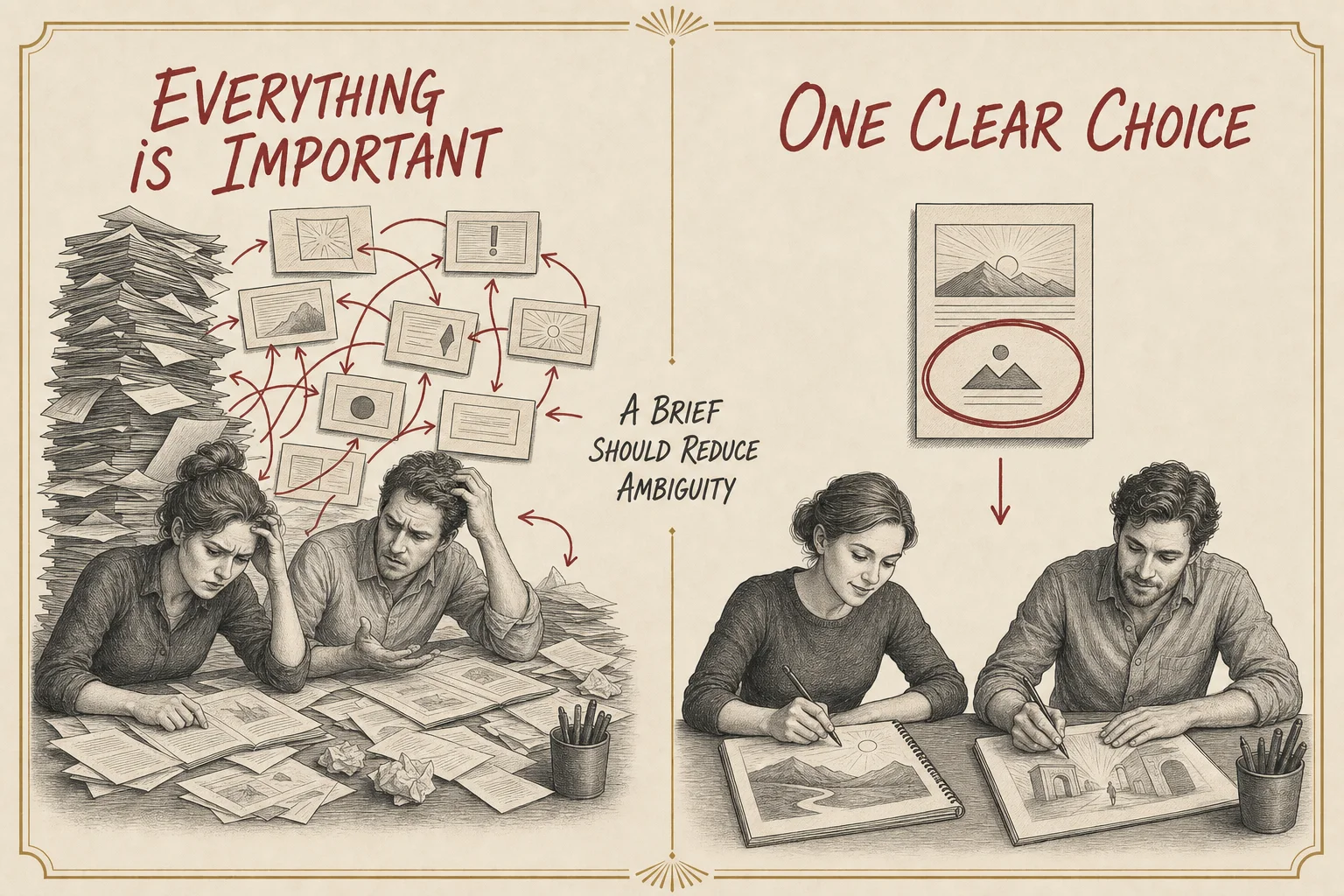
The most common failure is refusing to choose. Several audiences, messages, objectives and calls to action are placed together because each stakeholder wants protection. The result transfers political ambiguity to the creative team.
Another failure is confusing information with insight. A statistic can describe behaviour without explaining why it makes sense. An insight should reveal a tension or motivation that helps the creative team see a useful opening.
Finally, a brief can become a disguised execution request. Mandating the headline structure, visual metaphor, creator, soundtrack and emotional beat may produce compliance, but it eliminates the creative contribution the brief was supposed to unlock.
When everything is important, the brief has not made the decision yet.
Frequently asked questions
What should a creative brief include?
A useful creative brief includes the objective, audience, insight, single-minded proposition, proof, desired response and genuine guardrails such as formats, timing, mandatories and legal limits.
How long should a creative brief be?
It should be as short as clarity allows. One or two focused pages usually make the strategic choices easier to use, while research, data and source material can sit in supporting documents.
Who writes the creative brief?
Responsibility varies by organization. A strategist, planner, marketer or account lead may draft it, but the people who own the objective, product truth, customer evidence and final decision should contribute and align before creative development.
Is a creative brief the same as a marketing brief?
A marketing brief can define the broader business, market and campaign task. A creative brief narrows that strategy into a specific communication problem and direction for creative development.
What is a single-minded proposition?
It is the one strategic idea or promise the communication should leave in the audience's mind. It is an internal direction, not necessarily the final headline, slogan or execution.
Sources and further reading
- IPA: The Best Way for a Client to Brief an Agency ↗Industry guidance on marketing strategy, writing briefs and briefing agencies
- BetterBriefs and IPA: The issues with briefs and how to make them better ↗Guidance on strategy, objectives, targeting, creative process and evaluation
- IPA: One third of marketing budgets could be wasted ↗Global research on alignment gaps, brief quality and the value placed on briefing
- BetterBriefs: Research resources ↗Ongoing global research into marketing briefs and creative-idea evaluation
Explore related concepts
Put this guide to work
Start with the example above, then adapt the assumptions to your audience and evidence. Explore related advertising guides to compare approaches.
For a project collaboration or a question about applying the framework, contact Rishabh Vats. Include your objective, context and the decision you are working on.