Quick answer
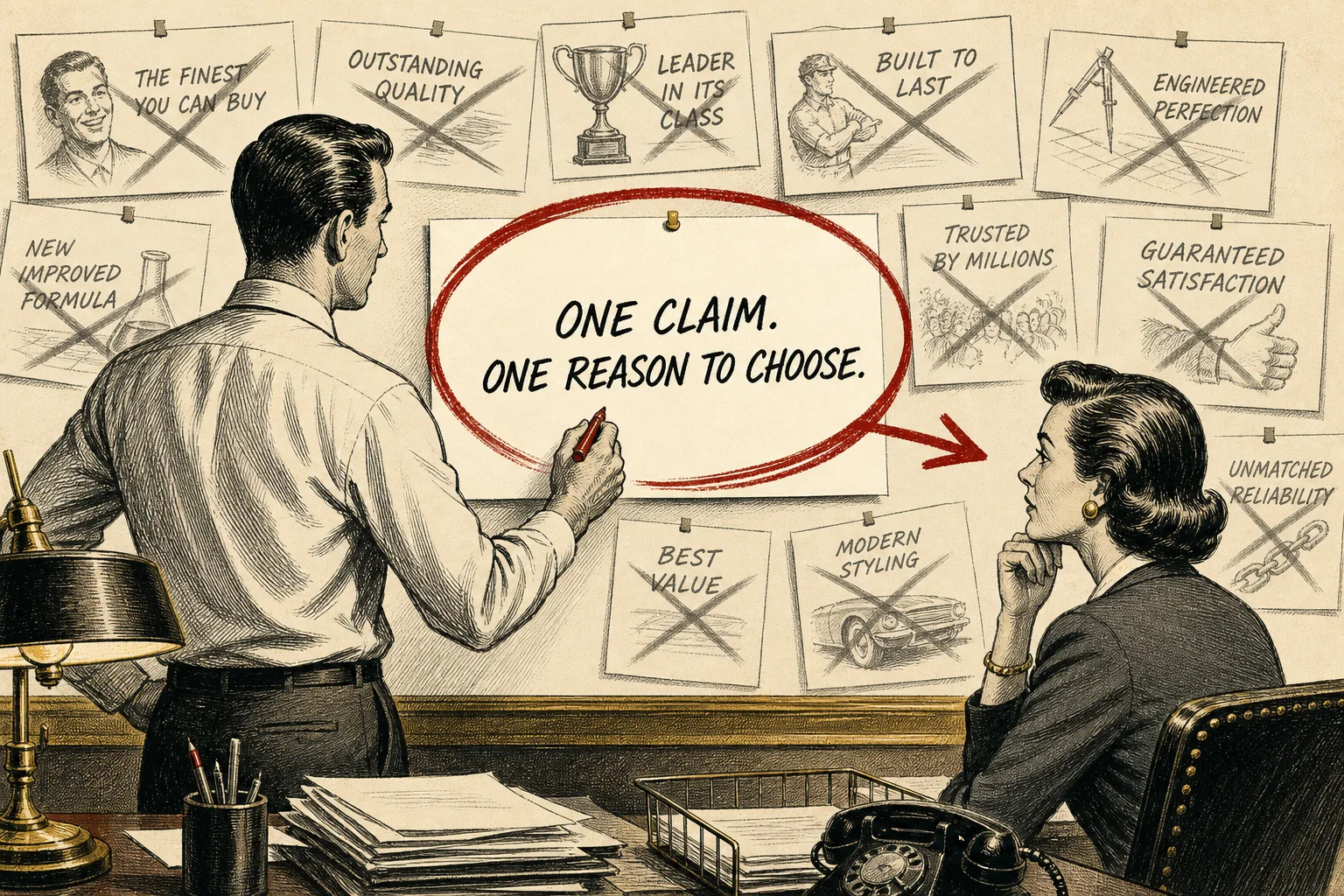
A unique selling proposition is a focused advertising proposition that promises a specific benefit, offers a claim competitors do not or cannot make in the same way, and is strong enough to influence customer choice. Rosser Reeves formalized the concept in Reality in Advertising. A USP should be supported by product or service truth and expressed consistently; it is not merely a clever slogan.
Start here: USP example: a repairable commuter backpack · Original sources
Explore this guide
What is a unique selling proposition?
A unique selling proposition, usually shortened to USP, is a single customer-facing proposition designed to give buyers a specific and competitively distinctive reason to choose. It states what the customer gets, why the offer is different and why that difference has selling power.
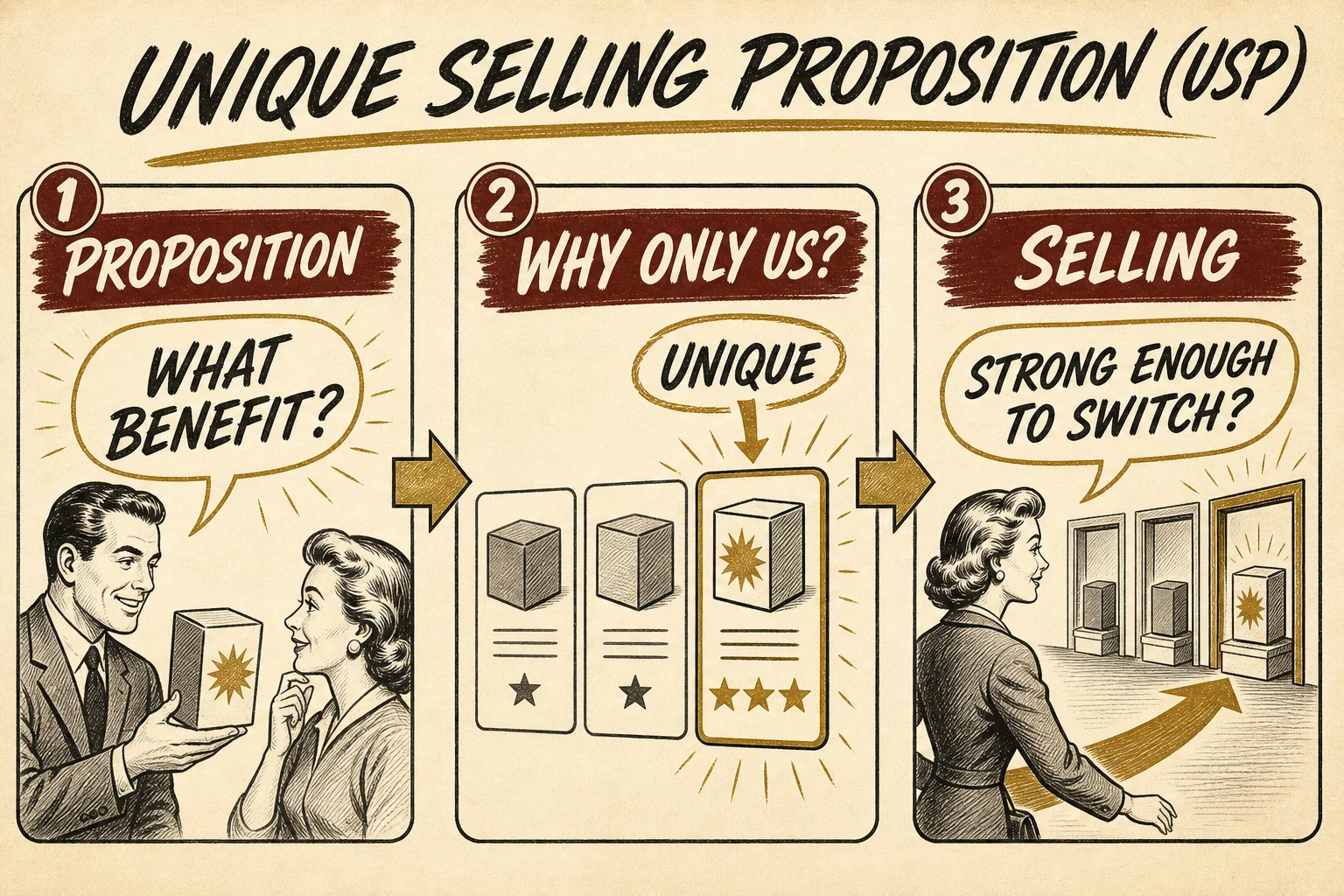
Advertising executive Rosser Reeves formalized the idea in his 1961 book Reality in Advertising after developing the approach at Ted Bates. His formulation contains three requirements: every advertisement should make a proposition, the proposition should be unique in the competitive field, and it should be strong enough to move customers toward the product.
The USP is often confused with a slogan. A slogan is a memorable verbal expression. A USP is the strategic selling idea beneath the expression. A slogan can carry a USP, but a rhythmic line without a specific benefit or difference does not become a USP through memorability alone.
Rosser Reeves and the hard-sell era
Reeves worked in an advertising environment shaped by mass media, packaged goods and repeated national campaigns. He argued that advertising's commercial job was to communicate a selling proposition, and that distracting execution could reduce how many people accurately received that proposition.
Reality in Advertising emphasized message penetration and what Reeves called usage pull: whether people who remembered an advertisement were more likely to use the product. His approach favoured continuity, clarity and a central claim rather than frequent campaign changes for novelty's sake.
Contemporary brand building includes emotion, distinctive assets, experience and cultural meaning that extend beyond one rational product claim. The useful lesson is not that every advertisement must become a literal demonstration. It is that communication should know which valuable and defensible reason it wants the customer to retain.
The three tests of a USP
The three requirements work together. A benefit without uniqueness is generic. Difference without customer value is trivia. A desirable and distinctive claim without proof may attract attention but collapse during experience or scrutiny.
Proposition
Promise a concrete benefit the customer receives from choosing the product or service.
- What exactly does the buyer get?
- Is the benefit clear without explanation?
- Does it matter in the buying situation?
Unique
Make a claim the competition does not, cannot or has not credibly established in the advertising field.
- Why only us?
- Which product truth supports the difference?
- Can competitors copy the words and remain credible?
Selling
Ensure the proposition is important and credible enough to pull customers toward the offer.
- Is the benefit strong enough to affect choice?
- Will customers believe it?
- Can the claim move more than existing users?
How to find a credible USP
Start with product and customer evidence. List the capabilities, materials, process, service model, expertise, access or experience the offer delivers differently. Then translate each fact into the outcome it creates for a priority customer in a real decision situation.
Study the alternatives the customer actually considers. Include direct competitors, substitutes, manual workarounds and doing nothing. Collect their repeated promises, product evidence and category associations. A claim is not unique because the team has not noticed another company using it.
Look for the overlap among customer importance, relative distinction and credible delivery. The strongest USP may be an exclusive capability, but it can also be a benefit competitors could theoretically offer yet have not claimed, organized or proven. That kind of opening is less defensible and requires continued evidence and brand ownership.
- Name the priority customer and buying situation.
- List product and service truths, not adjectives.
- Translate capabilities into customer outcomes.
- Compare the claim with real alternatives and their advertising.
- Select one benefit with meaningful selling power.
- Attach visible proof to the proposition.
- Test whether customers understand, value and believe it.
A practical USP formula
A working draft can use this structure: For [priority customer in a situation], [offer] delivers [specific benefit] unlike [relevant alternatives], because [distinct mechanism or proof]. This internal sentence forces the logic to become visible before creative compression.
The final public line may be shorter. Keep the proof nearby in the advertisement, landing page, demonstration or experience. If removing the explanation makes the claim sound unbelievable, the communication needs a clearer mechanism rather than stronger adjectives.
Write several candidate propositions and score them. Consider relevance, distinction, credibility, simplicity, emotional consequence, ability to demonstrate and endurance over time. The highest-scoring sentence is still a hypothesis until customers and market behaviour support it.
- For [specific customer and situation],
- [product or service] gives you [concrete benefit]
- unlike [real alternative],
- because [distinct capability, mechanism or evidence].
USP example: a repairable commuter backpack
The example below moves from a generic category claim to a proposition tied to one observable mechanism. It also shows why the competitive and customer tests cannot be skipped.
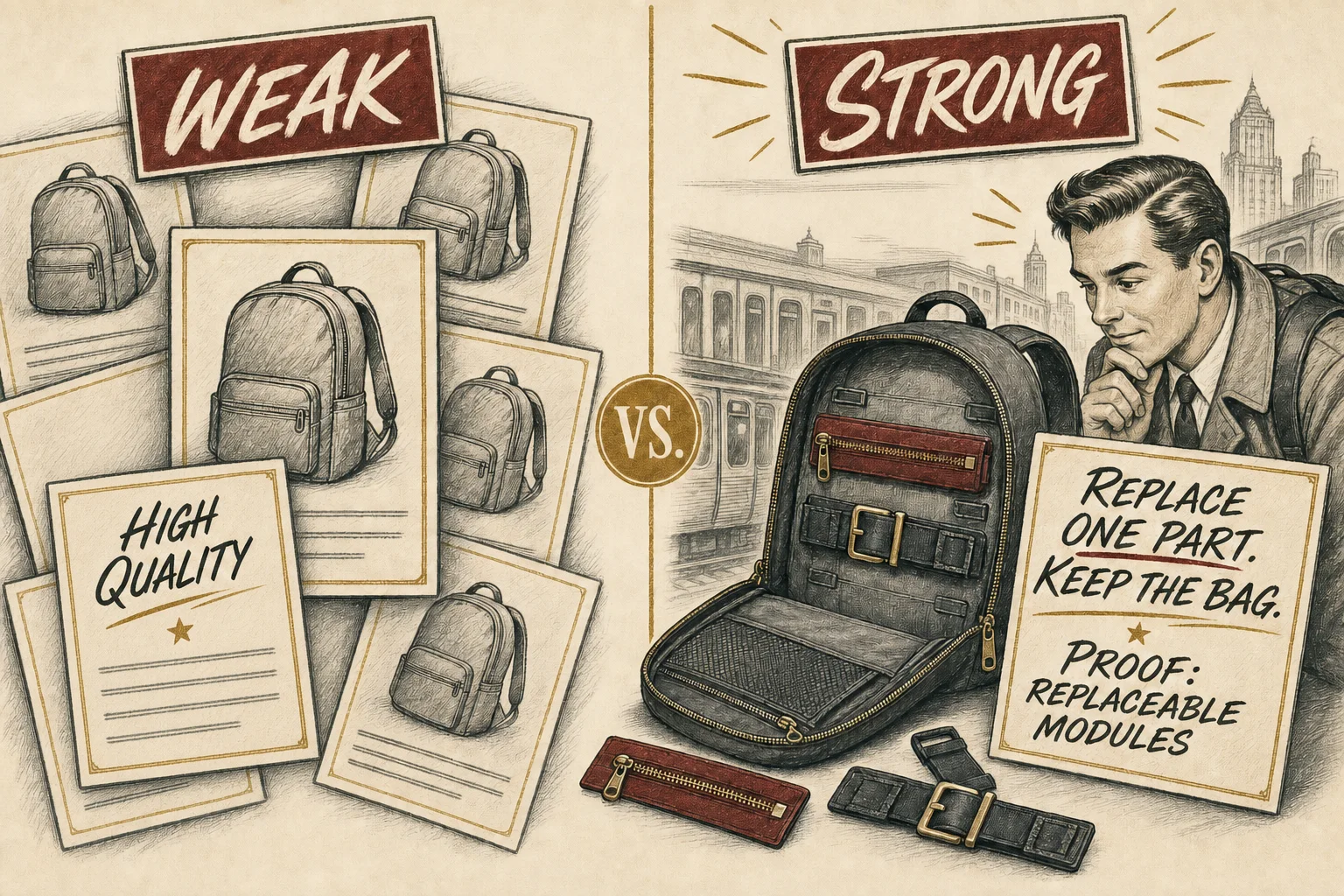
A repairable commuter-backpack brand wants a launch proposition. The product uses replaceable zip and buckle modules and provides a repair service. Competitors commonly claim quality, durability and responsible materials.
A high-quality backpack built for modern life. The sentence is positive but nonspecific, widely claimable and unsupported by a reason to choose this bag.
The components most likely to fail can be removed and replaced without discarding the whole backpack.
One broken zip or buckle does not end the useful life of the entire bag.
Review whether direct alternatives offer the same replaceable system or already make and prove an equivalent promise.
Replace one part. Keep the bag. Proof comes from visible replaceable modules, parts access and the repair service.
The line is only a valid USP if the benefit matters to the target, the competitive distinction is real and the company consistently delivers the repair mechanism.
USP vs positioning, value proposition and tagline
Positioning defines the broader place an offer should occupy for a target customer relative to alternatives. It includes the frame of reference, difference and proof and should guide the whole marketing mix. A USP is a focused selling proposition that advertising can communicate within that position.
A value proposition describes the bundle of value a customer can expect, including benefits and costs. It may contain several elements for a segment or use case. The USP selects one distinctive, sales-moving proposition rather than attempting to summarize all value.
A tagline is a public verbal asset. It may express the USP directly, signal a broader brand idea or simply aid recognition. Judge a USP by strategic substance and customer response; judge a tagline by how effectively it expresses the chosen idea and builds memory.
Turn the USP into effective creative work
Place the USP inside a creative brief as the single-minded proposition or central promise. Provide the audience insight, objective, proof and desired response. Creative teams can then dramatize, demonstrate or narrate the same proposition in many ways without diluting its strategic center.
Show the mechanism when it increases belief. A demonstration may compare performance, reveal a design, show a process or let customers verify the outcome. Testimonials and evidence can support the claim, but they should connect directly to the proposition rather than becoming unrelated praise.
Keep all executional elements working in the same direction. Visual attention, headline, body copy, product shot, creator, offer and call to action should reinforce or at least not obscure the proposition. Distinctive brand assets help people connect the claim to the right brand.
How to test a USP
Begin with comprehension. After brief exposure, can the intended audience state the benefit in their own words and identify the brand? Attention without accurate takeaway may strengthen the execution while losing the proposition.
Then test relevance and credibility. Ask which problem the claim solves, how important the outcome is, what evidence would make it believable and whether respondents know an alternative making the same promise. Avoid asking only whether people like the wording.
Use behavioural tests where possible. Compare qualified clicks, landing-page engagement, trial, conversion and reasons for purchase while controlling for audience, offer and media. A short-term response test does not measure all brand effects, but it can reveal whether the proposition helps the intended choice.
Common USP mistakes
The first mistake is mistaking praise for a proposition. Best quality, trusted service, innovative solutions and customer first do not tell buyers which benefit they receive or why the offer is different. Competitors can usually copy the sentence without changing anything.
The second mistake is manufacturing uniqueness through wording. A proprietary name for an ordinary feature may sound distinctive while delivering no different value. Customers need a meaningful outcome and evidence, not merely unfamiliar terminology.
The third mistake is choosing a narrow claim that sells once but constrains the brand or becomes obsolete. Evaluate whether the proposition supports the desired position, can endure product evolution and remains true across the experiences where customers will encounter it.
A USP is not the loudest claim. It is the clearest valuable difference the brand can prove and customers can use to choose.
Frequently asked questions
What is a unique selling proposition in simple terms?
It is one specific, valuable and competitively distinctive reason a customer should choose a product or service.
What are the three parts of a USP?
In Rosser Reeves's formulation, the advertisement must make a proposition, the proposition must be unique in the competitive field and it must have enough selling power to move customers.
Is a USP the same as a slogan?
No. A USP is the strategic selling proposition. A slogan is one possible memorable expression of that proposition or of a broader brand idea.
Can a service business have a USP?
Yes. Its distinction may come from process, expertise, access, guarantee, speed, specialization, delivery model or another service truth that creates a valued outcome.
Does a USP have to be impossible for competitors to copy?
The strongest propositions are hard to match, but Reeves also allowed a claim not otherwise made in the advertising field. A merely unclaimed advantage is less defensible and must remain truthful, relevant and supported by proof.
Sources and further reading
- Creative Hall of Fame: Rosser Reeves ↗Industry-institution profile of Reeves, Reality in Advertising and his unique selling proposition approach
- Kirkus Reviews: Reality in Advertising ↗Contemporary 1961 review describing the book's advertising philosophy and emphasis on uniqueness
- Branding Strategy Insider: The Advertising Wisdom of Rosser Reeves ↗Industry discussion of Reeves, the USP and focused competitive claims
- The Drum: Reality in Advertising by Rosser Reeves ↗Modern advertising-industry reflection on the book and the continued relevance of the USP